Thursday, October 1, 2009
Still Need Money
I'm really begging for money now, the camp is only a month away, and I can't buy any supplies until all $1,200 is in. It's a worth while cause, that's tax deductible. Even a $5.00 donation is appreciated, it adds up! Just go to www.peacecorps.gov/contribute and search my name or the project number 614212.

Bringing My Vegetables to Market
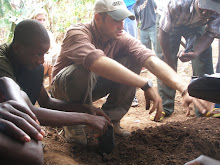
As I said in the previous blog my greatest sanctuary these past few months has been my garden down in the river valley. In June and July I often went there before sun-up and remained there all day tilling with my jembe, spreading compost, and planting new beds. I usually packed a lunch and took breaks throughout the day to eat sugar cane while I sit and chat with Mr Mkandawire (the old man who keeps the garden next to me). My afternoons were usually spent transplanting the young seedlings to bigger beds.
It's very therapeutic digging my hands into fresh black soil with the late afternoon sun on my back, the aroma of well-cured compost in my nostrels, and nothing but crickets and the cackle of a lilac breasted rollers chasing their mates for backround noise. At the end of the day as I walk back exhausted and happy from a good days work, I turn my hat backwards so I can watch Venus chasing the sunset in the west and the moon rising in the east as the first stars of the night begin to pop out.
I originally started this garden with the hope that my wildlife club would share the labor and sell the vegetables at the local market to raise money for the trip to Nyika National Park that they are constantly begging for, but as the school year got more busy, and the students afternoons got occupied with more pressing matters such as playing checkers in the trading center, or looking cool as they walked back and forth on the road through town I realized that it would just be my garden. I was fine with that since I had much more free time then I wanted, and it always makes such a great escape. I have gotten occasional assistance from my young roommate Sam and my friend John Gondwe who always get pleanty of vegetables in return. In July I bought a treadle pump with Mr. Mkandawire and Mr. Zgambo (my counterpart from the department of forestry) so we can water all of our gardens much easier. So now I have help from Mr. Zgambo's 3 sons once a week as they pump the stair stepper style pump and I man the hose.
The garden is full of a wide variety of vegetables this year thanks to all the seeds sent by good people back home like Carol Suzdak, Bill and Kay Shrenk, and of course my good old Mom. Sam and I have a big salad with every meal and have experimented with several different ways of cooking greens. We share with our neighbors and I always fill up a watering can with lettuce that I hand out to ladies on the path from my garden to the house, but there's no way I can use everything that is growing in my garden, so last week I decided to fill up two large maize sacks with vegetables and take them to Devin Rippner's (the closest volunteer to my site) Saturday market. It's a big market and I figured it would be a good way to show the kids in my wildlife club the profits they missed out on by not helping out in the garden. When I told people about my plans they mostly laughed and said “nobody in the village is going to buy strange vegetables that they don't know how to cook.” I said “they will once they've tasted them.”
Of course when we got to the market and unloaded the veggies from our bikes, everybody gathered around to see what the heck the Azungus were up to. I think the Azungu circus effect was the secret behind our initial sales, we probably could have unloaded a sack of eucalyptus leaves and people would have bought it just to eat what ever the Americans were eating. I used this to my advantage after I laid out a pile of lettuce I stood up and was at least half a foot over every bodies heads and said in Timbuka, “Do you see how big I am? It's because I eat this!” Most people laughed but some teenagers dug in their pockets for ten kwatcha to buy a pile.
A group of ladies were cooking nsima and goat meat to sell to the vendors who come from all over Rumphi west to sell their goods. I went over and gave each of them a pile of Indian mustard greens, and told them to cook it up with tomatoes and onions to add as an extra side dish to their meals. They could have them for free so long as they told everybody where they came from.
When things slowed down in the afternoon Devin made a big salad for sampling. We soaked the vegetables in Watergaurd the day before to kill any parasites and rinsed them. I mixed chigoona red lettuce, arugula, buttercrunch lettuce, mustard, beet greens, broccoli, chopped some onion chives, sliced two kinds of radishes, and one tomato to give people a little taste of everything. Devin cheated a bit by adding some vinegar and oil. People were very hesitant to eat uncooked vegetables, but I reassured them they were safe as I ate a little myself. You'd think I was serving cow dung by the look on the first women's face as she picked off a tiny leaf and slowly lifted it to her mouth, but her eye's grew as big as saucers when the salad dressing hit her tongue. She buried her face in embarrassed laughter when she saw my acknowledging smile. She came up nodding to the crowd and a wave of hands reached in for their own sample. It was hilarious watching people share the same reaction as the first women again and again. Granted a lot of people will be disappointed when they realize they can't recreate the taste of Devin's salad dressing without olive oil, and a dressing mix sent from America, but at least they're tasting some different vegetables for once.
In the late afternoon we got some help from Devin's friends Mackford and a Rasta who goes by the bold title of “God.” They stood behind my piles of veggies eating the salad with embellished moans of ecstasy saying, “Mmmm, kunowa chomene. Zie kuno gulani iyo.” (very delicious, come here and buy this.) I knelt by my heads of lettuce and piles of produce telling people how to cook the different greens; “fry the radish greens with peanut floor, cook the lettuce in in tomatoes, onions, and oil just for a minute, so that it doesn't turn into watery mush. I cut up radish slices with my leatherman and handed them out to everybody that listened.
It all payed off in the end, I was the first vendor to finish off what I carried, and at the end of the day we had either eaten or sold off every last leaf! I made over 2,000 kwatcha in 10 kwatcha increments, but unfortunately a 500 kwatcha note had fallen out of my pocket at some point in the chaos...zimachatika. We used some of the money to buy sweet potatoes, milk, sugar and biscuits to make a celebratory sweet potato pie for dinner.
The next morning in Mwazisi I had no shame in gloating about the profits we made and the fun we had selling them. Benidicto says he's coming with me next week to sell his tomatoes, and he will plant a wider variety of vegetables next year.
Finally out of Limbo
For the last several months my biggest project the agriculture extension office has been stuck in the ninth circle of bureaucratic hell waiting for materials. Last year we we got the project off to a good start; the community quickly made use of the funding that I secured from USAid to get the 10,000 stabalized soil blocks molded, but according to the agreement I made with the Rumphi department of Agriculture, the rest of the materials for the building would be provided by them. But no matter where you are, Malawi or America, things always move slower once they are left up to bureaucrats.
We built up to the window level by the end of last February, then not having any window frames our momentum came to a screeching halt. Ever since then I've become the most annoying fly in the department of agriculture's ear, “Is the money ready yet? Where are my window frames?” To which they always reply “Check back next week, should be an time now.” Back in Mwazisi I kept myself busy with my bee keeping projects, fish ponds, and tree nurseries but was aching to get back into construction mode. My garden down in the river valley became my greatest salvation. I have spent many hours there, tilling, planting, weeding, doing pull-ups on the branches of the mango trees, or just reading in the shade when it gets too hot to work. It's nice having a quiet place away from the village where I can work and think. When things have gotten especially frustrating then I listen to old “This American Life” and “Prairie Home Companion” podcasts while I work. I let the soothing voices of Ira Glass and Garrison Kheeler remind me of home.
Finally a couple months ago I decided to take a different route to getting the money. In my project proposal I stipulated that the funding for the construction of the building would come from the Malawian government, but not necessarily the department of agriculture. I found out about the Member of Parliament's constituency fund that can be used for any development they would like to make in their district. I called the newly elected Member of Parliament Hon. Austin Jatura Mkandawire, and told him about the project, I explained that this would be a very highly appreciated development in a part of his constituency where he got less votes in the last election (the other candidate was from Mwazisi). His reaction was awesome! He came to Mwazisi the next week to see what we had done so far, and promised to use his fund to pay for the window frames which are one of the most expensive items left for completing the construction of the building. I had to write another proposal then get it approved by the Village Development Committee, Area Development Committee and the District Assembly.
I was actually surprised how fast the money came from the constituency fund! The window frames actually arrived in Mwazisi yesterday. As luck would have it the department of Agriculture also just now came up with a large sum of money that we are buying other building materials with, and some of the iron sheets for roofing(which is why I'm in town today). We will start building again on Monday! . It's going to feel so good mixing cement first thing in the morning again Monday.
Monday, September 21, 2009
A Hike with the Good Lawyer Revisited
Now is a good time to recount one of my favorite Nyika trips as I beg my family and friends to donate money for a camp that is meant to influence the people living around the park to take a greater stake in protecting it (see previous blog). I think the way we feel about places has a lot to do with the people we associate it with, and I certainly associate Nyika with the man that first introduced me to it; a former Peace Corps volunteer and retired lawyer named Greg Doer.
He invited me on one of his adventures to Fingira rock when I first got to country. I was impressed to see the hiking strength of this 60 year old man, but most of all I admired his appreciation for the nature that surrounded him. Over the next year we became good friends, and he became a great source of advice as I was starting out as a Peace Corps volunteer. Greg and I shared some great debates, and plenty of laughs, but I saw him at his happiest in Malawi when we were hiking in Nyika. I was very happy when he invited me on his last hike before the end of his service.
Greg planned an epic trip for his finally that included climbing Nkhonjira mountain, fishing the Rumphi river and visiting Nyika's ancient Juniper forest. It would be all the more of an adventure since we would hike in the heart of the rainy season. He also asked the other two people I most associate with Nyika for the hike; his counterpart and Nyika game scout Manuel Gondwe (a certified bad-ass), and Greg's friend from Jumbi an ex-poacher turned Natural Resource Committee member Kondwani; a man that can best be described as the smiliest man in Malawi, as his name suggests (Kondwani means happy in Chitumbuka). Kondwani dubbed our crew the big four, and it seemed to me like an ideal group to spend my New Years in the mountains with.
Our first day of hiking was a late start because of a long heavy rainfall. We took shelter with a friend of Kondwani's that lived at the foot of Nkhonjira mountain. They generously cooked nsima and eggs for us, which gave us the strength to do one long hard push up the mountain when the storm broke. We agreed that Manuel and I would hurry ahead to set up camp and start the fire before sunset since we got such a late start. I had a hard time keeping up with the five foot tall hiking machine, as he moved up the ridge line at a fast steady pace.
As the sun set over Nkhonjira's shoulder the clouds and mist we were climbing through changed pink and purple. The whole scene became surreal, quiet, and beautiful. There's something truly magical about the calm after a big storm, and it was made all the more amazing by the sunset and the setting. I was already happy being up on the mountain above the noise of daily life in the village below....no screaming children, no blaring music from the beer dens. I only heard the occasional rumble of a thunderhead over Bolero, the wind through the miombo forests, and the call of a falcon that floated on thermals on the other side of the ridgeline which was a sheer drop-off that went down several hudred feet. I stopped and watched him as he hung suspended, and lifted a bit from an updraft then pointed his shoulder blades down and plummeted through the pink haze. My heart was pumping with adrenaline as I got back to climbing.
We slept under a tarp next to a creek that came from a primal forest near the top. After tea and rice porridge, we explored the forest a bit. It was a dense old growth forest brimming with life, vines hung from the branches of ancient towering trees that three of us could not wrap our arms around together. We took some pictures and caught up to Greg who was enjoying the view, of the bolero valley and beyond to where you could even make out the mountains over Mwazisi in the distance.
We hiked down the backside of the mountain through grassland and some extensive Musuku forests until we got bogged down in another heavy downpour. We wrapped ourselves in our tarps and waited it out for a while, before pushing on to Hana cave, a rock shelter that sits just above the Rumphi River. Greg found a huge bunch of large headed white mushrooms that we made into a delicious soup that we ate our Nsima with.
That afternoon Greg fished the Rumphi with a spin rod and lures. Supposedly there are still trout in the Rumphi from the dams that were stocked by the British in the 60's, but the river was way to high to catch anything in the heavy current where Greg was fishing. Kondwani jimmy rigged a small bamboo pole with some extra line and a lead weight, we baited it with crickets. I found a deep calm pool upriver just before sunset and managed to pull out 5 small catfish. We spent our new years eve eating mushroom soup and smoking the fish I caught in the mouth of the cave while greg played his penny whistle before sneaking off to his sleeping bag in the back of the cave. Kondwani, Manuel, and I stayed up late listening to Kondwani's wireless radio as news came in on BBC about the election violence in Kenya. I curled up in my sleeping bag and watched the Southern Cross rise between the horizon and the lip of the cave, as I thought about hopes for a more peaceful world, and the changes I wanted to make in my own life in the coming new year.
We awoke to a rainy and overcast 2008, and took our time enjoying a catfish and rice breakfast before we hiked 5km upriver so we could cross at a point just beneath a falls where the river dives beneath a boulder field that allows for easy crossing. We spent the rest of the day hiking up game trails, and bushwhacking up and down ridges, hillsides, and innumerable small valleys. Throughout the day we found ourselves in vast Msuku forests that slowed us down significantly as we were all hunched over sampling a few plum-sized fallen fruit before moving on to check the flavor of the next tree. As Greg said we were traveling at “Msuku speed.”
Around 5:30 we came across a poachers camp where they had just finished drying wild pig meat on a rack over the fire. The fire was still smoldering when we arrived, and they left various parts of the pig; they must have seen us coming up the valley, and took flight. Manuel went ahead a bit to see if he could catch them and confiscate their guns. We took over their camp and made a shelter out of tarps since it had been drizzling all day, but after sunset the clouds cleared out and the stars were absolutely beaming. I showed Kondwani all the constilations I could find. I fell asleep still watching the hot belt of the milky way turning overhead.
We ate a leisurely breakfast while we dried our socks and boots over the fire. Manuel extracted the tusks from the jaw of the wild pig the poachers left behind and Greg kept them as a souvenir. We spent the morning hiking up grassy hillsides, and scared up a common duiker, and 3 Kilspringers along the way and got to the Juniper forest around noon. There was an old dilapidated watchman's hut there that we took shelter in for the night.
The juniper forest was amazing. Some of the trees were up to 18 ft in circumference and they all towered high above us. We found one fallen juniper that had a kachere tree (a parasitic tree) growing in the middle of the trunk. The kachere tree was massive, at least 10 ft in circumference, but the fallen enormous juniper underneath it still hadn't even begun to rot showing what an incredibly hard wooded tree it was. I wouldn't be surprised if some of the Junipers were over 1,000 years old!
That afternoon Kondwani, Manuel, and I attempted to climb Kasaramba mountain while Greg stayed back at the watchman's hut resting his feet and cooking us beans for dinner. We failed to reach Kasaramba as we were chased back to the hut by an impressive thunderhead. As we hurried back I got some good pictures of a double rainbow at sunset. We fried up the last of my catfish and mixed them with the beans for dinner as the rain pounded on the tin roof of the little shack and thunder clapped all around the plateau. Kondwani did his best to patch the holes in the roof with chunks of Nsima (use # 101 of maize paste!).
We spent the next day hiking back to gregs favorite spot in Nyika, Fingira rock. It was a long hike over Nyika's vaste grasslands and through overgrown river valleys. We tried our luck fishing another spot on the Rumphi river around lunch time, but nothing this time. We saw two more bush bucks and spotted two mystery animals watching us from the ridge line silhouetted by the ominous storm clouds behind.
Though there are rock shelters actually at Fingira rock we always sleep down the hill in Mavungu rock shelter which is much closer to a water source. We found yet another patch of Mushrooms that we mixed with Lentils for our last meal on Nyika. I brewed a pot of coffee, and made it Irish with some Malawian gin. We toasted the New Year, and another successful adventure.
My only regret was that we didn't climb Fingira Rock to enjoy the view from the top. Since my first trip to Nyika two and a half years ago that is still my favorite spot in all of Malawi. But on that trip our feet were too sore and waterlogged, and the rock was too slippery to make the precarious 300M+ scramble.
I recently made the exact same trip with Manuel and my friend Mike Fong. We followed the same route but managed to make it to the top of Nkhonjira and descend to Hana cave in one day, then get to the Juniper forest the next day where we met up with four Peace Corps ladies that were hiking from the Eastern side of the park with my friend Dan Zgambo who I organized to guide them. Then all of us hiked over to Fingira rock together. It was an awesome trip, and Mike was the perfect hiking partner. We keep the same pace hiking, he's up for anything, and was ever positive (even when we meandered off of the correct path a bit on long 10 hour days of hiking). Not to mention he is an impressively light packer; he only brought a small day pack and a blanket roll, which was more than enough to support his simple needs. He kept Manuel and I entertained with his songs around the campfire each night. I really enjoyed sharing the brilliance of Nyika with my friends, the same way Greg shared it with me.
The last morning before we hiked out to Jumbi I insisted that we all hike up Fingira. I was the last one to get to the top as I was helping one of my friends get through some tricky spots. I found everybody enjoying the spectacular Panarama, with the wide open rolling grass lands of Nyika on the east side (it's like being up on pride rock in the Lion King). To the west my eyes followed the miomba woodland covered escarpment falling away to Jumbi and the long valley to Bolero, then north to the Mountains surrounding Nkhozo estates tractor plowed fields and on to the mountains that surround my house in Mwazisi. I thought back to my many trips to nyika; hiking, biking, and visiting with Malawians. When I stood on the very top and took in the grand view it sent a shot of adrenaline down my spine and I let out a WHOOOOEE that rang off of every corner of Nyika...I smiled at Manuel and said “I love this spot.”
Gearing up for another Nyika Wildlife Camp
Last year one of the most successful projects I took part in was the five day environmental mini-camp for teenagers living around Nyika National Park (see my blog from Nov 2008). Which is why I decided to organize another camp this year. The idea of the camp is to provide young people living around Nyika plateau with skills that they can use to improve their communities livelihood without poaching or otherwise destroying the parks resources. We also want to impart an appreciation for Nyika's uniqueness, and value to the environmental health of the entire Northern Region,.
This year we will teach the students about business skills, soap making, beekeeping, fish farming, and Jam making. There will be a focus on sustainable agriculture since farming makes up about 98% of rural Malawians livelihood. We will take a field trip to visit a Permactulture farm in Livingstonia, and also visit another Malawian lead farmer who is practicing a variety of sustainable techniques. We'll also teach practical sessions in compost making, contour line ridging and tree nursery propagation. But as I said the main idea of the camp is to impart a greater respect for the park itself, so we will have a lecture from a Malawian bird expert, and he will lead the entire group on a bird walk. We will also hike to Manchawe falls, and will be discussing Nyika's value as the Northern region's primary watershed the entire week.
Nyika is so unique in Africa, because most of it's 3,000 sq km are a grassy plateau that rises over 1800m. It supports a wide variety of birds and wildflowers that aren't found anywhere else in Malawi. More than 200 species of orchid have been recorded in the park, and 27 of them are endemic to Nyika alone. Sadly many people living around the park see orchids value only as a food delicacy. One of my friends working as a game scout, recently told me about catching a villager who had already dug up 9 buckets full of orchid bulbs that she was intending to sell in Chitipa where she can get as much as MK6,000 (about $40) for 1 bucket. This shows the lack of understanding people living around the park have for the uniqueness of this very special place. Which is exactly the issue that our camp is trying to address.
This is also a great opportunity for those of you who are interested to support one of my projects. I wrote the grant to fund the camp through Peace Corps Partners Program, which takes tax deductible contributions from friends and family of Peace Corps volunteers to put directly into our projects. All you have to do to donate is go to www.peacecorps.gov/contribute and search for either my name or enter the project number 614212 and make your contribution. I appreciate any support anybody can offer.
Tuesday, September 1, 2009
An Evening with Lucius Banda
This is an article I wrote for the Peace Corps magazine about my epic birthday with Malawi's best musician
Matt Zald (env 2009) and I were lucky enough to stumble upon a Lucius Banda concert in Mzuzu on a recent Sunday night. We heard the music blaring from the Mzuzu Sunbird hotel in the afternoon and decided to investigate. Little did we know that our wonderings would turn into an epic night in Malawi.
We actually didn't know who's concert we were walking into until the door man told us that Malawi's most famous Musician Lucius Banda would be playing. Anybody who has been in Malawi for more than a couple weeks knows Lucius Banda. He is essentially Malawi's national musician, any ewe you find outside your local village bottle store can recite hits like "Survivors" or "Malawi Wokongola" word for word for you as they shake their booty out of their loose fitting shorts. The man is so popular that he was elected to represent Balaka district as a Member of Parliament, but he quickly got out of that game.
The concert started mellow and easy around 3:30 and went on for over 3 hours. In the warm Sunday afternoon light, it seemed like a family picnic concert, as people who didn't manage to get a seat sat around the stage on the green grass. Children danced on the front steps and Banda crouched down to sing directly to his mini-fans, which made them absolutely loose their minds. One brave boy didn't loose his cool though he stepped up on the stage in front of a smiling Banda with his make believe microphone and lip-synced every word.
After the sun set things took a wilder side. When "Pa Mtengo wa Kachere" came on the whole crowd got to dancing, and really only stopped to watch the mesmerizing gyrations of one of his stunningly beautiful dancers. Banda brought some local Mzuzu rappers on stage to do a freestyle that had the crowd howling.
Our favorite stage dancer was a man in his mid-forties with a little pot belly and a missing tooth. He didn't look like one of Madonna's dancers, but he could dance anyone of them out of a job, and I'll guarantee you've never seen anybody who enjoys his job as much as that man. He smiled from ear to ear the whole show, and any time we made eye contact he threw us an enthusiastic thumbs up. During the last song he finally pulled Matt on stage so he could dance with the "Soldier" himself.
At the end of the night as the crowd was shuffled out we decided to take a shot and see if we could go and talk to the star. We were shocked when he pulled up two chairs for us and gave us a full interview. For the most popular musician in Malawi I was extremely impressed with his modesty and down to Earth nature.
He told us about growing up in a poor family in Balaka. His first introduction to music was his brother Paul's homemade guitar, made from a jerry-can, a stick and wire. Paul made Lucius into his Rhythm section, having him clap hands to keep rhythm. As Mr. Banda got older he found inspiration in Malawian Jazz guitar great Ungani Mkandawire. He also acknowledges the influence of South African Reggae legend Lucky Dube, and Micheal Jackson on his music. He admitted that he was brought to tears when he heard about Jackson's death.
Mr. Banda is finally gaining a bit of recognition beyond Malawi's borders. In fact he and his band recently returned from their tour of the UK, playing in the Splenda festival, as well as shows in London, Nottingham and Glasgow. He still hasn't made it to America but has had many requests to play in Indiana where there is a large Malawian population.
One of his proudest achievements is the work he has done to help other Malawian musicians get started in Music. As an MP he convinced the director of finance to allow all incoming instruments to enter Malawi Duty-free. He's helped many up and coming Malawian musicians to get established, such as Billy Kaunda, and Luscious Sakalu just to name a few. He thinks he's getting to old now to still expect to hit it big on the international music scene, but he holds out hope for some of the young Malawians he has helped along the way. He still worries that many of Malawi's young talented musicians don't develop because they lack quality instruments.
He became very interested when we told him about fellow volunteer Matt Jones' (env 2008) Malawi Music project that is trying to help introduce young people to music, and get them instruments. He even agreed to come to the upcoming Malawi music project camp if he is available.
Mr. Banda has a soft spot in his heart for Peace Corps volunteers; he had three Peace Corps teachers in secondary school all of which he could remember the full names of. He told us that he even bought his favorite teacher Chuck Thatcher's hiking boots when he went back to America for 200MK. These turned out to be the boots he stomped on his first stages in as a young musician.
After we snapped a picture with him he shook our hands and said "I really appreciate what you Peace Corps volunteers do in my country, I've been to Europe and seen the luxuries you give up to come and live in the bush for two years. It's no joke."
I'm Older Again
Well I've had my third and final birthday in Malawi. I had a great time with Peace Corps friends in Mzuzu. We ate cake, drank beers, saw Lucius Banda, and danced hard. I was happy to have been able to talk to my whole family. But as is more and more the case with every passing birthday (I'm now 28…gettin on now!) I start to think more and more about which direction my life is going. Especially being in my third year as a Peace Corps volunteer, the reality that has been my whole world for the past three years will be ripped away from me, and I'll be dropped back in the alternate universe that is America and have to figure out what the heck to do with myself.
I have decided that a farming apprenticeship would be the best transition from my life in Malawi to the life I want in America. I took advantage of being in town and having computer access to fill in applications for the two apprenticeships I am most interested in one on the Alan Chadwick farm at UC Santa Cruz, and the other at the La Boca Center for sustainability in Durango Colorado. I'm mulling over some other possibilities but these are the most appealing options so far. I actually put a lot of thought into the essays, because they were essentially asking me what I'm going to do with the rest of my life…uh ohh Dan and deep thinking are a bad mix. I want to post some of my essays on my blog because I'd like my friends and family to know that I really do have some direction, I'm just taking the long way around in getting there….It's kind of how I operate.
Explain your interest in an farm apprenticeship and how it applies to your future plans: The practical training I will receive from an apprenticeship is the best way to start down the path of achieving my dream of eventually running an organic farm. I have been an environmentalist and activist all of my life; but, a life of activism and dissent against obscure powers seems futile and meaningless if you remain dependent on the systems those powers put in place. I believe the best way to fight the excesses of greed and exploitation is to build a vital community outside of our current state of total consumerism, while simultaneously interacting with the larger populations that could most use a revival of agrarian values
I have a great deal to learn before I am ready to start the operation that I envision, and I have always learned best by doing. An apprenticeship on a farm that shares my same philosophy is the best way to get started gaining the skills I need to establish a farm in the community in which I eventually settle. Through my apprenticeship I intend to become an expert in organic horticulture, sustainable crop systems and rotations, animal husbandry, running and maintaining all necessary farm equipment, preparing harvested produce, and finally, getting it to market. If possible I would also like to gain more skills in agricultural extension, because I want a farm that is a place interested people can come and learn about sustainable agriculture, as well as how to produce food for themselves and their own community. After my apprenticeship, I would like to spend several years working on other farms that share the same philosophy to learn as much as I can about the logistics of running an organic farm.
I want to settle on one piece of land with people who share the same vision and start a farm that is a positive influence on the greater community. Instead of following the Earl Butz model of overproduction of commodity crops that is destroying our land, water, and farming communities, this farm will produce a variety of crops in a system based on the sun that rotates vegetables with legumes, deep-rooted grasses, then livestock, returning all waste to enrich the soil. This will be an excellent example of how organic farming can revive the degraded land and make a profit by connecting to niche markets to sell at a premium. Since the 1950's farming communities have rapidly failed as corn prices have fallen. We now have more prisoners in America than Farmers, and the dwindling numbers of farmers that remain are married to a horribly misguided system based on monoculture. This reliance on corn and soy farming has based our food system on fossil fuel. As Michael Pollen explains, when you add together the natural gas in the fertilizer to the fossil fuel it takes to make the pesticides, drive the tractors, harvest, and transport the corn, you find that it takes about fifty gallons of oil to grow one acre of corn. Put another way, it takes more than a calorie of fossil fuel energy to produce one calorie of food. There needs to be more examples of how eco-agriculture provides an alternative for farmers.
The farm I visualize will be a Community Supported Agriculture close to a large urban population not only to be near Organic produce markets but also so it will be accessible to the people who have become the most removed from the land from which their food comes. I want any farm I live on to be a place where city school groups and anybody else interested in agriculture can come and learn about organic farming. I want this farm to be a base for sustainable agriculture extension that will reach sections of society that otherwise would never have access to that sort of thing, such as the urban poor and paroled prisoners. These outcast members of our society who have become dependent on our broken food system only have cheap, highly processed, and unhealthy food available to them. They have become progressively more consumptive and degraded because of that system. Organic farming will not only provide these populations with a good source of safe and healthy food, but it will also give them a better understanding of the natural systems on which they depend. It will also pass on a valuable skill to many people that have little access to jobs. It is a disgrace that so many of our citizens living in the cities are unemployed while so many of our farms rely on illegal immigrants to harvest the food we eat.
I believe in Wendall Berry's philosophy of thinking little: focusing on ones own community and understanding the land they live on, what it offers, and what it requires from them. I believe sustainable organic farming is the best way to improve a piece of the world while spreading the joy of growing your own food to the people with whom you live and work. An apprenticeship on an organic farm is the best way to prepare to make that difference.
Describe your recent work experience: The past two and a half years as a Peace Corps volunteer have been the most transformative experience of my life. I am surer now of the direction I desire for my life then I have ever been. The joy of good hard work done with intention and in a community is unmatchable.
My day-to-day work in Malawi varies greatly, but it usually starts around 5:30 with me heading to either my garden or field depending on the season to till, weed, or harvest armed only with a Jembe (a local hoe). I usually head to the borehole around 9 or 10 am to collect water and prepare breakfast. On most Mondays after breakfast I go and work on a tree nursery with a women's group, Wednesday's I meet with the secondary school wildlife club, sometimes I spend my day building bee-hives with a local carpenter, other days I can be found at the fish ponds digging with a club of farmers who want to start as many ponds as they can before I leave. For the last several months I have spent most days mixing cement working with my team of five builders constructing our agriculture office. I usually return to my garden by late afternoon, and get back after sunset to have dinner with my neighbors, who I eat with to save the time and firewood that would be wasted just cooking for 1 person. I read or write by candlelight for maybe an hour before I start dozing, and am usually in bed by 8:00pm. I love my work in Malawi because I take it as it comes working on the task at hand, and it always has a practical use that I can see. I never have a day where I can't tell you what the purpose of my days work. Working outside every day with my hands is what I love, and as Anna Coomaraswamy said "Pleasure perfects work."
Before Peace Corps I worked for Open Space Mountain Parks near my hometown Boulder, Colorado on the Trail maintenance crew. My work included restoring existing trails, surveying and building new trails, construction of water bars, retaining walls, rock steps, fencing, and when the winter started forest thinning and clearing snags with a chainsaw.
Describe any previous farming experience: I have kept backyard gardens all of my life, but it wasn’t until after I graduated from college that I formally worked on a farm. I went to Scotland to play rugby and found work on Torrance farm an organic dairy farm with about 60 Jersey and Holstein cows. I helped with driving the cows, milking, weeding the pasture, mucking out the barns and milking biers, and spreading slurry on the pasture.
Douglas, the farmer I was working for, introduced me to WWOOF (World Wide Opportunities on Organic Farms) and I spent the next 7months moving from farm to farm all around Europe. During that time I did a variety of work, everything from work as an extra hand on a traditional family dairy farm in Parmigano Reggano Italy, to living in a tent and helping a community of squatters establish a newly acquired piece of land into an organic vegetable garden near Barcelona, Spain.
I am currently a Peace Corps volunteer working in the environment sector in Malawi. During my service my projects have focused on agriculture from bee-keeping to tree nurseries that include fruit trees and agro forestry trees like Gliricidia Sepium. My biggest project is an agriculture extension office that we are building out of stabilized soil blocks. The office will be manned by an extension worker appointed by the ministry of agriculture who will advise farmers on how to make the best use of their land, and maintain a variety of agricultural demonstrations around the office. We have already established some of those demonstrations including rainwater collection ponds, a fishpond stocked with tilapia, contour line ridging, intercropping maize with Tephrosia Vogelli (a nitrogen fixing tree that doubles as a natural pesticide against weevils), growing Rizobium inoculated soybeans to rebuild soil fertility, and a demonstration vegetable garden done with the near-by secondary school's wildlife club. I have also been growing most of my own food since coming to Malawi. In the rainy season I mostly grow maize, pole beans, sunflowers, soy, and peanuts. In the dry season I keep a vegetable garden in the river valley where I grow a huge variety of vegetables, melons, and fruits.
Describe your experience with cooperative living and working, and what you consider the advantages and disadvantages of it: My most memorable experience working in a cooperative living and working situation was WWOOFing on a communal farm in a mountain forest of Summerset England called the Tinker's Bubble. There are about 15 permanent adults and their children living and working there, with an assortment of volunteers working from a couple weeks up to a couple years. The community lives in a group of structures that were built on forty acres of woodland, pasture, garden, and apple orchard allowing them to be completely self-sufficient. The community avoids using fossil fuels whenever possible; cooking on a wood stove or open fire, using wind and solar energy for light, and a workhorse named Sam for any heavy moving or framework. The Tinker’s Bubble residents manage the woodlands harvesting trees that are milled with a steam engine and used for building all of their own structures. Almost all of their produce is grown organically in their numerous gardens, two poly-tunnels, and a single greenhouse. The community also has several cows from whose milk they make yogurt and cheese. Each member of the community contributes about 30.00 pounds a week towards living expenses. Most of the residents earn extra money from cider making, working in private gardens, and wood furniture crafting. Every Monday the community has a meeting where they decide what jobs need to be done that week and they divvy up the work.
I really enjoyed working on this farm, and felt like I quickly fit in as a useful part of the community. The primary disadvantages of cooperative living and working are that it can sometimes be difficult to find consensus so planning can become deadlocked, and of course when people are working and living so close together sometimes tensions can get high and personalities inevitably conflict. But I think all of these problems can easily be overcome with a little patience and understanding; as far as I saw they always were at the Tinker's Bubble.
I think the advantages far outweigh the disadvantages for living and working in a Cooperative situation. Living and working in a cooperative is just like being in a community, it is a support network. Work becomes far more efficient when it can be divided out amongst many people. Working cooperatively allows every individual to fill their own niche in the farm, putting their skills towards the progress of the whole. Wendall Berry explained the goodness of good work in a cooperative setting best; "It brings us home from pride and despair, and places us responsibly within the human estate. It defines us as we are: not too good to work without our bodies, but too good to work joylessly, selfishly or alone….Community are the bonds that give our individuality a use and a worth; it is only to the people that know us, love us, and depend upon us that we are indispensable to as the person we uniquely are."
Subscribe to:
Posts (Atom)