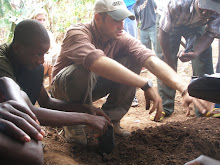
I was put in a bad mood first thing this morning when I walked out of my house and found that my biggest and healthiest Chamwamba tree was destroyed by one of the kids who live next door. Since I started out planting trees around my house when the rains started I’ve lost count of how many trees the kids have destroyed. “What’s the point” I muttered to myself as I tried to splint the broken trunk, “She’ll just destroy it again in a week.”
As I walked over to talk to her parents I was told that Nya Nfuni (the women who cooks for me when I teach at the secondary school, and one of my closest friends in the village) was sick and went to the clinic in the middle of the night. I went straight to the clinic from there, and found her looking weak and scared, quite a contrast from the bright eyed super women that I call my Malawian Mama. She explained matimba chimbira yichoko, yichoko (My heart is running slow.)
The frightened look on her face really had me worried, and was heavy on my mind as I walked to Mr. Semi the Agriculture extension worker’s house to fulfill our agreement to plant some of his Vetiver grass around our newly dug future fishpond to try and prevent soil erosion and silting. When I got there he complained that it was too late to start work, “the sun’s too high to go to the field now.” His lame excuss to put off the job really annoyed me because it wasn’t even 7:30 am yet and still nice and cool out, but since I asked him to show me the best way to plant vetiver and it was going to come from his garden I was at his mercy.
I was really annoyed as I walked back home because my whole morning was planned around my agreement to meet Mr. Semi. It was then that I noticed a women that I recognized but didn’t really know looking at me and laughing. When I asked her what she was laughing at she said “Mukunyamula Jembe”- “You’re carrying a hoe.” My mood went from bad to furious… The common Malawian belief that all Americans and Europeans are completely incapable of doing any manual labor absolutely infuriates me. I gave a sarcastic response that I’m sure she didn’t understand but could read the meaning behind my tone. I decided I better get out of Mwazisi before I snap on somebody.
I decided to take a bike ride, I had a good excuse to escape since I was already planning to go to Berludgi where I had heard about a man who had extra pvc pipes sitting around that I was interested in using for a rainwater harvesting tank. So I decided to take the long bike ride and visit some friends along the way mostly just to get out of Mwazisi for a day and have a little adventure.
I was already feeling better as I rode out of town; I just needed the excitement of a change of scene to change my mood. I stopped to talk to a man carrying a baby in a bundle on his back the way women do. I told him I’d never seen a man carrying his children, and that it was good to see a man taking care of the children for a change. He laughed and turned around to show off the smiling bundle on his back. I made a quick stop to remind the women from our beekeeping group about an upcoming meeting. I turned off the main road to go over the pass that leads to Pangara; a small village between Mankhali Hill and the mountains on the border of Vwaza Game Reserve. At the foot of the pass you go through a set of boulders that people call the elephants feet, they seem like a gate to the more untouched wilderness behind the mountains where the effect of people living on the land hasn’t taken it’s destructive toll yet. I love going down this road because I always feel like I’m really heading into the bush. There are much more trees on the surrounding mountains and I always seem to have the rocky neglected road to myself, so all I can hear is the breeze in the trees, and the array of Malawian bird songs.
My friend Bwana Nfuni is one of the reasons that Pangara’s surrounding wilderness is better preserved. He is my favorite village headman, because while many of the other village headman are drunks and over inflated egomaniacs, he is a true naturalist. His house is surrounded by trees of all sorts; fruit, palm, and nitrogen rich deciduous trees to improve the soil. Not only does he plant a lot of trees at his home, and chase people from cutting trees on the hills, but his more than thirty bee-hives hanging from the branches of trees is an assured protection of the trees it hangs between. He’s the best bee-keeper anywhere near Mwazisi and has been an indispensable asset for our beekeeping group sharing his knowledge of honey and wax production, and offering advice on how to go about harvesting the hives. I’m really glad to have a village headman like him so close to Mwazisi, he is the rare positive social deviant needed to set an example for everybody else to follow.
I stopped by his house for a visit but found that he was away teaching at the Primary school which he continues to do despite long having been retired. So I headed on to my destination of Beraludgi, and found my man with the PVC pipes. His name was Mr. Boti, and I found him sitting under a shade weaving a basket. He turned out to be about the handiest person I have encountered in Malawi. Aside from being a basketweaver, he is also a carpenter, metalworker, and welder. The man actually converted old bike parts into a grinder, and welding equipment. I was amazed to say the least, and I was equally impressed by his modesty. As I Marveled at his makeshift workshop he just smiled and remained under his shade continuing his work, never saying more than a couple words.
When I asked about the pipes he sent his sons behind the house and they emerged with three 20 centimeters in diameter pipes, which was exactly what I was looking for. He offered them to me free of charge when I know the same pipes would sell for more than 500 kwatcha a piece in Mzuzu. I insisted on paying him a little for them, and also promised to come back sometime with a whole bunch of Vegetable seeds. A promise he seemed to appreciate.
As I left his place my fortune turned from good to downright miraculous, way out there in the bush where Mr. Boti lives I saw a truck I recognized passing on the narrow path. I waved it down and was happy to see that it turned out to be one of my neighbors brother who is running for MP in 2009 who is driving out to every back road outpost trying to garner up early support for his campaign. He recognized me from his brother’s swearing in as a chief, and agreed to carry the pipes back to my house on his way back to Mwazisi. When I left this morning I didn’t even know if I would find any pipes. Not only did I find exactly what I was looking for but got them for next to nothing and got free transport from way out in Berludgi. The gods must have decided to make up for my crap morning.
From Berludgi Mr. Boti pointed me in the direction of a back road to Kapenda, where the nearest Peace Corps volunteer to me is placed. So I decided to drop in and visit him. Unfortunately when I got there I found that he was away as well in Mzuzu, but it was a sunny day and worth the ride just to see another road. When I got to Kapenda a Thunderhead rolled in, the sun was blocked out and the downpour started. I took shelter and chatted with some entertaining guys drunk on homemade wine from tea leaves. They enjoyed helping me to improve my Chitumbuka, and we shared a lot of laughs. The cloudburst ended as suddenly as it had blown in. I took advantage of the clearing, and started heading for home.
I made one more stop at an ant-hill where I was told I could get a bit of cell-phone network. From there I sent my Mom a birthday greeting via text message, and got her to call me back so we could talk longer. When I heard her groggy voice I remembered that it was 5: 00am in Colorado. I sang happy birthday, which brought a sleepy laugh. We had a long and good conversation. I’m always happy to be transported back to Colorado by my mother’s voice every now and then.
I got back to Mwazisi just after dark and went straight to the hospital to see Nya Nfuni. She still looked weak, but was clearly much better. I sat with her and chatted for a while, and told her in terrible Chitumbuka that “I was worried about my Malawian mother all day.” The smile that spread on her face warmed my heart, and made me feel like I am exactly where I’m supposed to be right now, a huge change from this morning when I was feeling so out of place.
As I walked back to my house I heard drums starting up in the trading center. I went to see what was going on and found the village women starting a dance circle. Across the road, I could see some drunken men half dancing, half stumbling in the candlelight in BBC’s bar, which seemed very cave like and sad compared to the beauty of the deliberate and fluid movements of the women under a clear beaming African starry night. I sat on the front steps of Chipesa’s shop with my neighbor’s children and watched the women’s hips gyrate and smiles glow in the dim lantern light. I’ve said it many times before and I’ll say it again, “African women sure are beautiful!”
Thursday, March 27, 2008

Tuesday, January 15, 2008
Kuzizima article: A Great Example
This is an article I wrote for the Kuzizima magazine last month (a newsletter distributed to all of the Peace Corps volunteers in Malawi). Most of you probably didn’t know that I have experienced a bit of Peace Corps romance since I’ve been here. I quickly hit it off with a second year Environmental volunteer named Corie, but unfortunately last month she was medically separated due to a rare illness that is effecting her pituitary gland and has caused her to develop diabetes isopodous. We were really just getting to know each other but I really gained a lot from our relationship, and that’s what this article is all about; the lessons that other Peace Corps volunteers and myself can draw from Corie. Enjoy!
As most of you know by now Corie Eastridge from the second year environment group was medically separated last month after being diagnosed with lymphocytic hypophysitis a rare disease caused by an autoimmune disease and has been sent back home to Chicago. I know I was not the only person in Malawi to fall for this extraordinary red head, her charm and ever-positive attitude made her one of the most mutually loved people in Peace Corps Malawi. So the news of her sudden departure created an emotional typhoon for all who know her. It’s hard to imagine a Peace Corps gathering in Lilongwe without Corie’s wild dance moves, twisted sense of humor, and constant giggles unbashfully bubbling up in any situation no matter how inappropriate. I had precious little time to get to know Corie, but in that short time I was fortunate to learn a lot from her attitude, her approach to Peace Corps, as well as the circumstances that led to her premature end of service.
In regards to what I learned from her circumstances it has given me a renewed appreciation for my own service. Her experience has taught me that being here is an opportunity not to be taken for granted; it can be over in a flash as she was sent home without having the chance to go back to her village and pack or say goodbye. Corie’s experience encourages me to view everyday here as a gift. Sometimes volunteers start to look at their service in Malawi as an endurance contest, which is no way to stay happy, and in my opinion is counterproductive to Peace Corps goal of providing Malawians with a positive image of Americans through its volunteers. Seeing our service as a gift reminds us that this is a chance to experience a world that, at least in my case, I never could have imagined a year ago. It’s also the opportunity to at least try to make a small difference in one of the worlds most under-developed countries. There is also the opportunity everyday to have a positive impact on some individual’s life, which can be something as small and simple as a smile and kind words to the shy unconfident woman you might pass on the street, or something as significant as helping your neighbor start the small business that changes his or her whole life.
Corie’s attitude while working here in Malawi is one of the lessons that I could most benefit from striving to imitate. Being able to put your frustrations aside and always remain positive the way Corie has done can make any volunteers service more effective. The positive influence Corie had on the people of Maliera was inspiring. When I first visited her site I saw that she approached every interaction with a smile on her face, and always left the other person infected with a smile on their face too. I was amazed at how well integrated she was at her site, and the way people in Maliera truly loved her, clearly a product of her cheery attitude and good-nature towards everybody in the village. She is the definitive example of a Peace Corps volunteers’ role as a diplomat for the American people. Ten years from now when the children of Maliera have grown up, when they think about America they will associate it with the smiling ginger from Chicago they loved as a child. That’s an everlasting impact that can’t be expressed on any description of service.
Corie wasn’t just here as a diplomat though, she also took her approach to being a capacity builder very serious which we can also draw lessons from. She worked with the community to start a peanut butter making project, which is not only an income generator, but also provides a source of much needed protein and fats locally for the areas many malnourished children. She pressed on with this project despite many stumbling blocks, one of which I was there to witness. The group she was working with had become frustrated with making stabilized soil blocks (SSBs) and were ready to abandon the method all together and cut down trees to burn bricks, a method they were much more familiar with. I probably would have gotten frustrated with them being so quick to abandon SSBs. She had worked hard on writing a funding proposal, budgeting, and working out all of the tedious details. Corie did not get angry though. She calmly explained the benefits of doing SSBs and left the decision up to them, and ultimately they were willing to give the soil blocks another try. As their experience with the machine grew, they quickly got a system down, and by the next time I visited her again the building was finished and the group was looking to extend the project to a youth community center. This was the first major project they had ever done as a group, and her patience and persistence helped them see what they were capable of doing together. The new enthusiasm of the group shows that this project is sure to continue and grow even though she has left. The lesson that I think we as Peace Corps volunteers can draw from this is to strike the balance of remaining persistent and confident in our ideas without ever being forceful or patronizing.
People in Corie’s village won’t be remembering her simply because of the projects she did, but mostly they will remember how she was smiling and laughing all along the way; this is the most important lesson that I see in Corie’s example. Even though her service ended early and unexpectedly, she can feel comforted that she made the most of her experience every day that she was here, just simply by being so happy. While she was in Malawi she fostered nothing but positive relationships with people who certainly won’t be forgetting her anytime soon. . Corie came to visit my village for just two very short visits, but people still ask me about her all the time, they say, “Oh Corie, that one is sooo cheerful.” This is probably the most important lesson I have learned form Corie, the importance of just having fun and enjoying each day as it comes to you. Just because somebody works hard and takes their assignment seriously, doesn’t mean that they have to take themselves seriously; at least Corie illustrated this with every giggle, at regular rate of about five per minute.
That propensity to always be laughing was the most important thing I learned from Corie, and also happens to be the first thing that drew me to her. At my groups swearing in one of the Malawian speakers from the department of forestry said “We understand that Lady Bill Clinton may be the next President of America.” Every American present at least shared a quiet chuckle with the person next to them, but one giant laugh carried over the whispers without reservation, and I turned around to see Corie’s ear to ear grin. I knew then that she was somebody who knew how to enjoy life, but as I spent more time with her I became more and more impressed with her ability to laugh and appreciate the world around her regardless of the circumstances. These last few months she has really demonstrated this ability. Even when she was in tears telling me about her frustrations with not being allowed to go and say goodbye to anybody in her village she joked about her sickness as a punishment for all the evil jokes she has told over the years. Her ability to laugh and remain positive despite having her entire world turned upside down by this very serious illness is nothing short of remarkable.
I really have no frame of reference to understand what she is going through as she deals with this rare illness that will affect her for the rest of her life. I can only hope that I would have half the strength and dignity that she has demonstrated so far. Corie said it best the last time I spoke to her about how little the doctors knew about what is happening to her, “Eh, We’ll see what happens….everything always works out.” That sort of optimism and ability to see the futility in worrying about what is to come in ones life is something rare and beautiful, and I am ever-thankful to Corie for providing such a spectacular example to try to live up to.
As most of you know by now Corie Eastridge from the second year environment group was medically separated last month after being diagnosed with lymphocytic hypophysitis a rare disease caused by an autoimmune disease and has been sent back home to Chicago. I know I was not the only person in Malawi to fall for this extraordinary red head, her charm and ever-positive attitude made her one of the most mutually loved people in Peace Corps Malawi. So the news of her sudden departure created an emotional typhoon for all who know her. It’s hard to imagine a Peace Corps gathering in Lilongwe without Corie’s wild dance moves, twisted sense of humor, and constant giggles unbashfully bubbling up in any situation no matter how inappropriate. I had precious little time to get to know Corie, but in that short time I was fortunate to learn a lot from her attitude, her approach to Peace Corps, as well as the circumstances that led to her premature end of service.
In regards to what I learned from her circumstances it has given me a renewed appreciation for my own service. Her experience has taught me that being here is an opportunity not to be taken for granted; it can be over in a flash as she was sent home without having the chance to go back to her village and pack or say goodbye. Corie’s experience encourages me to view everyday here as a gift. Sometimes volunteers start to look at their service in Malawi as an endurance contest, which is no way to stay happy, and in my opinion is counterproductive to Peace Corps goal of providing Malawians with a positive image of Americans through its volunteers. Seeing our service as a gift reminds us that this is a chance to experience a world that, at least in my case, I never could have imagined a year ago. It’s also the opportunity to at least try to make a small difference in one of the worlds most under-developed countries. There is also the opportunity everyday to have a positive impact on some individual’s life, which can be something as small and simple as a smile and kind words to the shy unconfident woman you might pass on the street, or something as significant as helping your neighbor start the small business that changes his or her whole life.
Corie’s attitude while working here in Malawi is one of the lessons that I could most benefit from striving to imitate. Being able to put your frustrations aside and always remain positive the way Corie has done can make any volunteers service more effective. The positive influence Corie had on the people of Maliera was inspiring. When I first visited her site I saw that she approached every interaction with a smile on her face, and always left the other person infected with a smile on their face too. I was amazed at how well integrated she was at her site, and the way people in Maliera truly loved her, clearly a product of her cheery attitude and good-nature towards everybody in the village. She is the definitive example of a Peace Corps volunteers’ role as a diplomat for the American people. Ten years from now when the children of Maliera have grown up, when they think about America they will associate it with the smiling ginger from Chicago they loved as a child. That’s an everlasting impact that can’t be expressed on any description of service.
Corie wasn’t just here as a diplomat though, she also took her approach to being a capacity builder very serious which we can also draw lessons from. She worked with the community to start a peanut butter making project, which is not only an income generator, but also provides a source of much needed protein and fats locally for the areas many malnourished children. She pressed on with this project despite many stumbling blocks, one of which I was there to witness. The group she was working with had become frustrated with making stabilized soil blocks (SSBs) and were ready to abandon the method all together and cut down trees to burn bricks, a method they were much more familiar with. I probably would have gotten frustrated with them being so quick to abandon SSBs. She had worked hard on writing a funding proposal, budgeting, and working out all of the tedious details. Corie did not get angry though. She calmly explained the benefits of doing SSBs and left the decision up to them, and ultimately they were willing to give the soil blocks another try. As their experience with the machine grew, they quickly got a system down, and by the next time I visited her again the building was finished and the group was looking to extend the project to a youth community center. This was the first major project they had ever done as a group, and her patience and persistence helped them see what they were capable of doing together. The new enthusiasm of the group shows that this project is sure to continue and grow even though she has left. The lesson that I think we as Peace Corps volunteers can draw from this is to strike the balance of remaining persistent and confident in our ideas without ever being forceful or patronizing.
People in Corie’s village won’t be remembering her simply because of the projects she did, but mostly they will remember how she was smiling and laughing all along the way; this is the most important lesson that I see in Corie’s example. Even though her service ended early and unexpectedly, she can feel comforted that she made the most of her experience every day that she was here, just simply by being so happy. While she was in Malawi she fostered nothing but positive relationships with people who certainly won’t be forgetting her anytime soon. . Corie came to visit my village for just two very short visits, but people still ask me about her all the time, they say, “Oh Corie, that one is sooo cheerful.” This is probably the most important lesson I have learned form Corie, the importance of just having fun and enjoying each day as it comes to you. Just because somebody works hard and takes their assignment seriously, doesn’t mean that they have to take themselves seriously; at least Corie illustrated this with every giggle, at regular rate of about five per minute.
That propensity to always be laughing was the most important thing I learned from Corie, and also happens to be the first thing that drew me to her. At my groups swearing in one of the Malawian speakers from the department of forestry said “We understand that Lady Bill Clinton may be the next President of America.” Every American present at least shared a quiet chuckle with the person next to them, but one giant laugh carried over the whispers without reservation, and I turned around to see Corie’s ear to ear grin. I knew then that she was somebody who knew how to enjoy life, but as I spent more time with her I became more and more impressed with her ability to laugh and appreciate the world around her regardless of the circumstances. These last few months she has really demonstrated this ability. Even when she was in tears telling me about her frustrations with not being allowed to go and say goodbye to anybody in her village she joked about her sickness as a punishment for all the evil jokes she has told over the years. Her ability to laugh and remain positive despite having her entire world turned upside down by this very serious illness is nothing short of remarkable.
I really have no frame of reference to understand what she is going through as she deals with this rare illness that will affect her for the rest of her life. I can only hope that I would have half the strength and dignity that she has demonstrated so far. Corie said it best the last time I spoke to her about how little the doctors knew about what is happening to her, “Eh, We’ll see what happens….everything always works out.” That sort of optimism and ability to see the futility in worrying about what is to come in ones life is something rare and beautiful, and I am ever-thankful to Corie for providing such a spectacular example to try to live up to.
Wednesday, November 28, 2007
The Ladies Take a Field Trip
As I mentioned in my last blog, the call of adventure beckoned my friends to leave Mwazisi earlier than they had planned. They decided they wanted to do something nice for the community before leaving, which developed into the idea of renting a Matola and taking the women of Mwazisi to Vwaza Game Reserve to do a game drive, and have a day outside the village to be free of the monotony of their usual daily activities. We just invited women because we knew they were much less likely to have an opportunity like this, and we also knew that the dynamic would change if men also came along, the women wouldn’t feel so free and open to enjoy themselves.
We left late and our number of women was reduced because of a funeral at a near by village. But I was happy that the journey carried on anyways, and the 23 women who did come were abuzz with excitement as the truck pulled out of Mwazisi. All of the ladies were dressed in their best dresses, kept beaming smiles, and sang songs the entire way. One often repeated verse was “Tizamuwona zovu lero” (“We will see elephants today”). My name was also featured occasionally in the songs, which I always acknowledged with a grateful smile. We stopped in Kapenda to pick up Willard Nshanti, the Parks and Wildlife official I asked to escort us. He came out of his house wearing his parks uniform, a bright red sash across his body, and had an M16 rifle. He also came out with a huge grin on his face that gave the scene an element of comedy. I caught Leslie’s eyes and could see that she found it every bit as funny as I did.
We powered through the sandy patches in the road where Matolas tend to get stuck and reached the park close to 9:00 am. Unlike the last time I biked to Vwaza there were no elephants sitting at the gate waiting to greet us, but plenty of baboons instead. Before we started the game drive the park director addressed all of the ladies outside his office. He talked about the problems caused by people coming into the park to collect firewood, and the importance of starting our own tree nurseries, and planting trees near people’s homes to ensure that firewood is available inside the village, and people don’t need to be so dependent on the surrounding forests’ resources. I was happy to hear him say “Chonde mukupanda blue gum na milina chara” (“Please don’t plant eucalyptus and milina trees”). These are two very invasive trees that do more harm than good for the soil, but are the most common trees planted by Malawians because of how fast-growing they are.
After the talk we loaded back up on the Matola to go to Kazuni Lake, where animals can usually be seen at the water hole. Within just a few minutes of driving the women in the front of the Matola started calling out “Wona nkhumba,” pointing at two warthogs running through the woods, frantically being chased by three small piglets.
The next animal we saw was my favorite; a massive sabel. I was immediately reminded of my friend Tony’s animated description of what a sabel looks like, in the way that only Tony can describe something… He jumps from his chair to give himself room for the depiction. “Man you’ve never heard of a sable? It’s the most bad-ass animal in Malawi bro. It’s built like a freaking elk, man, but has a hump on its back like a bull-moose,” as he tucked his shoulders back and curled his neck to replicate the stout muscular neck of the beast. “And it’s big man, real big,” which he indicated by waving his hand high above his head. “And it has two long spiraling antlers” as he outlined the antlers over his head with his index fingers. “Most bad-ass animal in Malawi bro… So when one of the women pointed at one gracefully gliding through the woods I couldn’t help but smile, Tony’s description was dead-on, it was the most bad-ass animal I’ve seen in Malawi. We watched as it glided around each tree and over high shrubs with the fluidity of water running around stones in a streambed, despite having the muscle mass of a bull elk.
We saw scattered herds of bush-buck that could of just as easily have been white-tales grazing through fields of clover somewhere in eastern Wyoming. Then we pulled over by Kazuni Lake to get out and take a closer look at a herd of hippos under the supervision of Mr. Mshanti and his M16. He kept encouraging us to get closer and closer, which surprised me because I’ve always heard that hippos are the most dangerous animals in Africa. We were made bold by the guns under the park official’s arm, and inched within 30 feet of the huge and dangerous animals.
I especially enjoyed watching the women who I have only ever known in the context of Mwazisi. It was awesome being able to watch them having so much fun, and losing themselves in their wonder and amazement when one of the hippos opened its huge jaws to let out a yawn revealing its massive teeth for tearing and grinding the flesh of its unlucky prey. After the hippo closed its mouth and dipped under water to swim away the silence was broken by the women looking at each other still with wide excited eyes, chattering and laughing high on the adrenaline of the moment. As we walked over to a good place to take some group pictures, I continued to watch the women who were really feeling free and having a ball, carrying balls of dried elephant dung on their heads, and laughing the whole time. We spent a long time next to the lake just taking picture after picture, more of the ladies than of the hippos. I’m glad we caught all of those smiles when they were at their most magnificent.
The rest of the trip was botched up by Mshanti bringing us on a wild-goose chase that led us down a long bumpy road to the other side of the park to try and see a new animal sanctuary that it turned out we couldn’t even get clearance to enter. But it didn’t really matter the whole trip was worth the first couple hours of smiles.
We stopped off at a local market on the way back to hide from an oncoming storm, and eat lunch. The frustration of our misguided adventure to the sanctuary fell away as we shared fried corn on the cob, and bananas we bought from the market, and rice and eggs the women carried. As we sat in a storefront and talked about the days events those smiles came back. A mini-van full of teachers returning from a nearby school passed through the same village on its way back to Rumphi, which was our final destination after the field trip. The women told us we should take advantage of the free ride, and they would head back to Mwazisi after the rain had passed. So I loaded our bags while the ladies said their final goodbyes to Leslie, Annie, and Sarah knowing that they would most likely never see them again. My American friends insisted on hugs which surprised the ladies, who awkwardly embraced their new found friends. I could see they were sad to say goodbye to these foreigners who flashed into their lives and brought them to see a place just down the road from them but they had never had the chance to enjoy. They giggled as they gave into the hugs and I was happy to see the smiles flash again as we hopped in the van.
We left late and our number of women was reduced because of a funeral at a near by village. But I was happy that the journey carried on anyways, and the 23 women who did come were abuzz with excitement as the truck pulled out of Mwazisi. All of the ladies were dressed in their best dresses, kept beaming smiles, and sang songs the entire way. One often repeated verse was “Tizamuwona zovu lero” (“We will see elephants today”). My name was also featured occasionally in the songs, which I always acknowledged with a grateful smile. We stopped in Kapenda to pick up Willard Nshanti, the Parks and Wildlife official I asked to escort us. He came out of his house wearing his parks uniform, a bright red sash across his body, and had an M16 rifle. He also came out with a huge grin on his face that gave the scene an element of comedy. I caught Leslie’s eyes and could see that she found it every bit as funny as I did.
We powered through the sandy patches in the road where Matolas tend to get stuck and reached the park close to 9:00 am. Unlike the last time I biked to Vwaza there were no elephants sitting at the gate waiting to greet us, but plenty of baboons instead. Before we started the game drive the park director addressed all of the ladies outside his office. He talked about the problems caused by people coming into the park to collect firewood, and the importance of starting our own tree nurseries, and planting trees near people’s homes to ensure that firewood is available inside the village, and people don’t need to be so dependent on the surrounding forests’ resources. I was happy to hear him say “Chonde mukupanda blue gum na milina chara” (“Please don’t plant eucalyptus and milina trees”). These are two very invasive trees that do more harm than good for the soil, but are the most common trees planted by Malawians because of how fast-growing they are.
After the talk we loaded back up on the Matola to go to Kazuni Lake, where animals can usually be seen at the water hole. Within just a few minutes of driving the women in the front of the Matola started calling out “Wona nkhumba,” pointing at two warthogs running through the woods, frantically being chased by three small piglets.
The next animal we saw was my favorite; a massive sabel. I was immediately reminded of my friend Tony’s animated description of what a sabel looks like, in the way that only Tony can describe something… He jumps from his chair to give himself room for the depiction. “Man you’ve never heard of a sable? It’s the most bad-ass animal in Malawi bro. It’s built like a freaking elk, man, but has a hump on its back like a bull-moose,” as he tucked his shoulders back and curled his neck to replicate the stout muscular neck of the beast. “And it’s big man, real big,” which he indicated by waving his hand high above his head. “And it has two long spiraling antlers” as he outlined the antlers over his head with his index fingers. “Most bad-ass animal in Malawi bro… So when one of the women pointed at one gracefully gliding through the woods I couldn’t help but smile, Tony’s description was dead-on, it was the most bad-ass animal I’ve seen in Malawi. We watched as it glided around each tree and over high shrubs with the fluidity of water running around stones in a streambed, despite having the muscle mass of a bull elk.
We saw scattered herds of bush-buck that could of just as easily have been white-tales grazing through fields of clover somewhere in eastern Wyoming. Then we pulled over by Kazuni Lake to get out and take a closer look at a herd of hippos under the supervision of Mr. Mshanti and his M16. He kept encouraging us to get closer and closer, which surprised me because I’ve always heard that hippos are the most dangerous animals in Africa. We were made bold by the guns under the park official’s arm, and inched within 30 feet of the huge and dangerous animals.
I especially enjoyed watching the women who I have only ever known in the context of Mwazisi. It was awesome being able to watch them having so much fun, and losing themselves in their wonder and amazement when one of the hippos opened its huge jaws to let out a yawn revealing its massive teeth for tearing and grinding the flesh of its unlucky prey. After the hippo closed its mouth and dipped under water to swim away the silence was broken by the women looking at each other still with wide excited eyes, chattering and laughing high on the adrenaline of the moment. As we walked over to a good place to take some group pictures, I continued to watch the women who were really feeling free and having a ball, carrying balls of dried elephant dung on their heads, and laughing the whole time. We spent a long time next to the lake just taking picture after picture, more of the ladies than of the hippos. I’m glad we caught all of those smiles when they were at their most magnificent.
The rest of the trip was botched up by Mshanti bringing us on a wild-goose chase that led us down a long bumpy road to the other side of the park to try and see a new animal sanctuary that it turned out we couldn’t even get clearance to enter. But it didn’t really matter the whole trip was worth the first couple hours of smiles.
We stopped off at a local market on the way back to hide from an oncoming storm, and eat lunch. The frustration of our misguided adventure to the sanctuary fell away as we shared fried corn on the cob, and bananas we bought from the market, and rice and eggs the women carried. As we sat in a storefront and talked about the days events those smiles came back. A mini-van full of teachers returning from a nearby school passed through the same village on its way back to Rumphi, which was our final destination after the field trip. The women told us we should take advantage of the free ride, and they would head back to Mwazisi after the rain had passed. So I loaded our bags while the ladies said their final goodbyes to Leslie, Annie, and Sarah knowing that they would most likely never see them again. My American friends insisted on hugs which surprised the ladies, who awkwardly embraced their new found friends. I could see they were sad to say goodbye to these foreigners who flashed into their lives and brought them to see a place just down the road from them but they had never had the chance to enjoy. They giggled as they gave into the hugs and I was happy to see the smiles flash again as we hopped in the van.
First Visitors
It never fails…when you’re late, everything goes wrong. I spent most of my morning looking for a lost ATM card so I could withdraw enough money to get to Koronga to meet my friends who had flown in to Dar Es Salaam and taken the train through Tanzania to the Northern border of Malawi. When I finally got on the mini-bus I sat for an hour and a half while the conductor waited for more passengers to board. Despite my persistent pleading, “Tiene, tiene chonde nachedwa” (Let’s go, Please I’m Late) he refused to start the journey until the bus was full to capacity. We finally started pulling out of Mzuzu when the side door suddenly fell off the overfilled minibus. All I could do was laugh as I looked at my watch to see that it was a half an hour until the time I agreed to meet my friends at the Chitimba roadblock, which was still one and a half hours drive away. While the driver and conductor put their Malawian ingenuity together to reattach the door I had visions of my friend’s good will towards me fading as they sat in the hot African sun on the side of the road surrounded by Malawian children with outstretched hands repeating the primary English phrase they learn from their friends in areas where tourists pass; “Azungu, give me my money”…A heck of a way to spend their first day in Malawi. I felt I was already failing as a host in Malawi.
The ride from Mzuzu to Chitimba is beautiful; it skates around the southeast corner of Nyika Park and affords spectacular views of dense green forests, with baboons wandering out to gawk at the cars as they wiz by. Then as you make your way down the escarpment Lake Malawi suddenly appears before you. Being the third biggest lake in Africa, its sheer enormity always gives a thrill when it comes into view. It was my first time taking this road but I couldn’t enjoy it fully with my waiting friends weighing heavy on my mind. Two and a half hours past the time I said I’d be there the driver told me we were approaching the Chitimba roadblock. I climbed out of the hot, packed minibus with my apologies all planned out, and found my friends sitting under a palm tree with smiles on their faces as they enjoyed a fruit picnic and chatted with one of the English speaking roadblock officers. They all greeted me with big hugs and warm salutations. Not a complaint was uttered and when I brought up my late arrival, they just shrugged their shoulders, and said “Eh we figured you would be here a little late so we only got here a half hour ago. We’re on African time now, just glad to be here.” I was relieved and excited; right away I knew this was the way things were going to go for the next month. There was no need for me to ever worry about having to entertain anybody, the ladies were always game to go with the flow and enjoy any experience that came their way. They were open to anything and everything and were never phased by the common frustrations that seem to come with life in Malawi.
Sarah, Leslie, and Annie had been on rugby tour with the Missoula Maggots for a few months, and were tired and ready to spend some time in my village. Mary’s only destination was Africa, but she was also content with spending time in Mwazisi where she could do what she loves and does best…teach. The plan was for them to stay with me for a month while they helped the form four students (high school seniors) prepare for their MSCE exams, the most important test most Malawians will ever take. A students entire scholastic carrier boils down to whether or not they do well on this month long series of exams. Unfortunately, by the time my friends arrived, the time for teaching and studying was pretty much over, but we were able to put together a few mass cramming sessions, that turned out to be very helpful, according to all the students who came. An opportunity to practice in the eleventh hour would make a difference. The secondary school teachers view the second half of the third term as the beginning of their vacation, so some of the teachers leave to go to Mzuzu or Zomba to work on advanced certificates while others spend the remainder of the school days sitting under a mango tree, and leave the form fours to study on their own. Form one and threes spend their time idling in teacherless school blocks.
From talking to a few Peace Corps Education volunteers I gathered that the essay portion of the exams was the most difficult section for most students. So in the weeks before my friends arrival I took over some of the other teacher’s open slots with the form fours and gave them the best tutorial I could come up with on essay writing. The day before I left to go to Chitimba I had the form fours write an essay that I took from an old test paper. When the ladies got to the village we looked them over to see what common mistakes we could shore up at the last minute.
The essays showed that we had a lot to teach in only a few days. Most of the students, even after my previous crash course, had no concept of how to structure an essay. They wrote in bullet points and rarely made a complete sentence. The best way for us to help was to set up a workshop, where we reviewed the structure of a good essay: thesis, support, support, support, and a conclusion, with an emphasis on the importance of answering the who, what, when, where, and why in any question. We then gave them three practice questions to choose from and allowed them 50 minutes to write the exam, to simulate the actual tests, which have a strict time limit. After they finished we went over some basic vocabulary and grammar in small groups. Mary was swarmed by students looking for help in math, which she handled with the grace and professionalism that inspired the phrase that the rest of us probably repeated a thousand times over the next month, “Mary’s so fricken amazing!”
We spent the rest of the afternoon marking papers, and giving extra help to students with more in depth questions. My friends fully embraced the task; I was amazed at the thoughtful detail with which they marked the papers, and the encouraging comments they gave. Especially Leslie who works with the Boys and Girls Club of Denver, I was impressed to see how quickly connected with my students, and how comfortable they became with her.
One example that sticks out came near the end of their visit, Leslie came to work on English with the form three class to organize a pen pals exchange with the students she works with in Denver. It was the first time she had met the form threes and I didn’t have time to help in that class because I had two periods of physical science to teach with the form one class next door. I brought Leslie into the class for a quick introduction, and explanation about what she would have them do, then I hurried over to my class and taught for the next 2 hours straight (cramming in as much review as possible to try to get them ready for final exams the following week.) When I left my class I found that she was still teaching…well, sort of. When I walked in all of the students were gathered around Leslie looking at her camera, roaring with laughter. Apparently she just recorded some of them doing their best Malipenga dance, and they were watching the replay. After she helped all of them write their letters, she just hung out with the students and chatted for a long time. The whole house had a glow when I peeked in; the students all had grins from ear to ear. They were obviously not used to a teacher staying after a lesson for casual conversation, and certainly not for singing and dancing. When I entered the classroom Leslie was finalizing plans for the whole group to reconvene at one of the girl’s house for a dance party. I asked “hey why haven’t I ever been invited to a dance party.” I have to say I was a bit jealous.
In addition to teaching, the ladies also had a chance to be students. They came with me to my regular Chitumbuka lessons with Nya Bowe (Mrs. Kayera). She was ecstatic to have a full class, and not just working one on one with me. I could tell she spent some time organizing a lesson plan and presented the lessons from my Peace Corps language manual as well as any of my Peace Corps trainers. Sarah was the most serious about learning Chitumbuka, and was Nya Bowe’s star student. She took detailed notes in class, and spent any down time studying through her little notebook, or bouncing her pronunciation off me to make sure it was correct. When she greeted people out on the street they stopped surprised and said “Ehh, Wamanyeko.” Everybody was very impressed and appreciative that Sarah was putting forth so much effort to learn a language she wouldn’t be able to use anywhere outside of the Northern region of Malawi. The older people around the village would say, “That Sarah, she works very hard, and is so cheerful. The others, Ahh Watondeka.” Which means failing, but really they were probably doing much better than I did in my first couple weeks, but paled in comparison to Sarah.
All of my friends immediately fell in love with Nya Bowey, with her infectious smile, and outgoing nature that is so uncommon among Malawian women around foreigners. They decided that we needed to have Nya Bowey bring her whole family over to my house so we could cook dinner for them. The girls were excited to cook ever since they discovered my friend Mr. Mwasa’s garden where he has been growing a variety of vegetables from the seeds my friends and family have been sending from back in the states. They were like kids in a candy store running around the plot picking fresh basil, green onions, romaine lettuce, beet greens, Swiss chard and bush beans. “Why didn’t you show us this earlier,” they asked me bitterly, “we should have been eating this the whole time.”
After there first experience with cooking in the village over a three stone fire my friends quickly understood why I pay my neighbor Nya Funi to cook a little extra of what ever she is making for her own family. Between carrying water from the borehole, improvising utensils, and suffocating in a smoky kitchen, cooking in the village becomes quite an undertaking. We also cooked a big meal for Nya Funi’s family on a different night, which we started preparing around 11:00 am by making corn tortillas from scratch, then made a roasted corn salsa, a pot of beans that took half the day itself to cook on the fire, and a vegetable fry-up that gave my Malawian friends an opportunity to sample foods that they had never seen before.
It was a time consuming undertaking, but we had a blast seeing what we could put together in a group effort. We all worked well together, once we found our rhythm, with Leslie and Annie generally the brains behind the operation, and the rest of us carrying out their orders. Annie really held the whole thing together with her level head and her ability to make the most out of everything that was available to us. We joked that it was practice for our future self-sustaining community back in Colorado or Montana, when we get tired of our wandering ways and finally set roots. The idea of communal living back in America was a common topic of discussion throughout the girls visit, it seemed to start out as a joke, but lead to more serious discussions about the ideal place, and whether it was possible to be self-sufficient in a big city like Denver, and by the time Sarah was leaving we had some of my Peace Corps friends getting into the idea and asking if we had started thinking about a year when it could start coming together.
Both meals were a big success. Many of my other friends ended up dropping by and tasting our creation. It was certainly like nothing they had ever tasted before. Some of it was a little to alien for the Malawian tongue, which is used to only the blandest of foods. But sometimes as soon as Nya Funi put the spoon to her mouth, her eyes would show that she was experiencing an epiphany of flavor. She looked almost shocked as she pointed her spoon at the bowl of vegetables declaring “kunowa chomene” (very delicious). When the Kayira family came over we lingered behind my house under the stars long after our bellies were full to capacity, chatting and laughing. With encouragement Sarah broke out the guitar and we started singing American folk and country songs, to repay all the singing and dancing Nya Bowe’s daughters had done for us. Leslie encouraged me to get up and dance, so that we could lure out some big laughs from the Malawians, so she could sneak a picture or two. The resulting snaps will surely transport anyone of us who were present back to that night of contented companionship.
There are too many great cultural exchanges to relate from the girls visit without writing a book. Even though they didn’t stay in my village as long as we originally planned, their impact on the community far exceeded my expectations, and will certainly have a lasting effect. One day they came with me to Football training. I think its fairly safe to assume this was the first time anybody in Mwazisi had ever seen a women in shorts let alone playing football. When the ladies first showed up ready to play, the guys roared with laughter and bounced around slapping high fives with excitement, probably mostly from seeing my friends in shorts. But when we started playing pass and defend their jaws dropped as Annie, who played soccer at the University of Montana ran circles around some of the best players. Apparently word of the ladies training with the team spread through the village, because before I knew it a crowd had assembled around the pitch, as big as the crowd for most games. What made me most happy was seeing all of the young girls who were also watching as the village heroes of Gan United running their absolute hardest and calling out a women’s name to pass them the ball, and then joking around with them the same way they would with any other teammate during a lull in the action. This is very significant in a village where men and women seem to live in separate worlds, in most cases barely speaking to each other beyond the expected formal greetings (although there are certainly exceptions.)
Eventually the itch to strap on a backpack and continue the adventure of exploring the world became too strong for my friends to keep wading around in the calm pool of village life in Mwazisi. An itch I can relate to, and I’m glad they acted on it because it brought them to one of the great wonders of Africa, and rafting on the big waters of the Zambezi river; separate adventures that you will all have to get from them if you ever get the chance to buy one of them a beer. I just count my blessings for having the friends that I have. Not many people would be willing to embark on a trip like theirs and experience life in Africa the way they did. They are four remarkable women and I’m glad we had the opportunity to share the experiences that we did, and now when I write to them about Mwazisi, they can put it into context in a way that nobody else can, that is until you come to Malawi and see the Mwazisi valley for yourselves.
The ride from Mzuzu to Chitimba is beautiful; it skates around the southeast corner of Nyika Park and affords spectacular views of dense green forests, with baboons wandering out to gawk at the cars as they wiz by. Then as you make your way down the escarpment Lake Malawi suddenly appears before you. Being the third biggest lake in Africa, its sheer enormity always gives a thrill when it comes into view. It was my first time taking this road but I couldn’t enjoy it fully with my waiting friends weighing heavy on my mind. Two and a half hours past the time I said I’d be there the driver told me we were approaching the Chitimba roadblock. I climbed out of the hot, packed minibus with my apologies all planned out, and found my friends sitting under a palm tree with smiles on their faces as they enjoyed a fruit picnic and chatted with one of the English speaking roadblock officers. They all greeted me with big hugs and warm salutations. Not a complaint was uttered and when I brought up my late arrival, they just shrugged their shoulders, and said “Eh we figured you would be here a little late so we only got here a half hour ago. We’re on African time now, just glad to be here.” I was relieved and excited; right away I knew this was the way things were going to go for the next month. There was no need for me to ever worry about having to entertain anybody, the ladies were always game to go with the flow and enjoy any experience that came their way. They were open to anything and everything and were never phased by the common frustrations that seem to come with life in Malawi.
Sarah, Leslie, and Annie had been on rugby tour with the Missoula Maggots for a few months, and were tired and ready to spend some time in my village. Mary’s only destination was Africa, but she was also content with spending time in Mwazisi where she could do what she loves and does best…teach. The plan was for them to stay with me for a month while they helped the form four students (high school seniors) prepare for their MSCE exams, the most important test most Malawians will ever take. A students entire scholastic carrier boils down to whether or not they do well on this month long series of exams. Unfortunately, by the time my friends arrived, the time for teaching and studying was pretty much over, but we were able to put together a few mass cramming sessions, that turned out to be very helpful, according to all the students who came. An opportunity to practice in the eleventh hour would make a difference. The secondary school teachers view the second half of the third term as the beginning of their vacation, so some of the teachers leave to go to Mzuzu or Zomba to work on advanced certificates while others spend the remainder of the school days sitting under a mango tree, and leave the form fours to study on their own. Form one and threes spend their time idling in teacherless school blocks.
From talking to a few Peace Corps Education volunteers I gathered that the essay portion of the exams was the most difficult section for most students. So in the weeks before my friends arrival I took over some of the other teacher’s open slots with the form fours and gave them the best tutorial I could come up with on essay writing. The day before I left to go to Chitimba I had the form fours write an essay that I took from an old test paper. When the ladies got to the village we looked them over to see what common mistakes we could shore up at the last minute.
The essays showed that we had a lot to teach in only a few days. Most of the students, even after my previous crash course, had no concept of how to structure an essay. They wrote in bullet points and rarely made a complete sentence. The best way for us to help was to set up a workshop, where we reviewed the structure of a good essay: thesis, support, support, support, and a conclusion, with an emphasis on the importance of answering the who, what, when, where, and why in any question. We then gave them three practice questions to choose from and allowed them 50 minutes to write the exam, to simulate the actual tests, which have a strict time limit. After they finished we went over some basic vocabulary and grammar in small groups. Mary was swarmed by students looking for help in math, which she handled with the grace and professionalism that inspired the phrase that the rest of us probably repeated a thousand times over the next month, “Mary’s so fricken amazing!”
We spent the rest of the afternoon marking papers, and giving extra help to students with more in depth questions. My friends fully embraced the task; I was amazed at the thoughtful detail with which they marked the papers, and the encouraging comments they gave. Especially Leslie who works with the Boys and Girls Club of Denver, I was impressed to see how quickly connected with my students, and how comfortable they became with her.
One example that sticks out came near the end of their visit, Leslie came to work on English with the form three class to organize a pen pals exchange with the students she works with in Denver. It was the first time she had met the form threes and I didn’t have time to help in that class because I had two periods of physical science to teach with the form one class next door. I brought Leslie into the class for a quick introduction, and explanation about what she would have them do, then I hurried over to my class and taught for the next 2 hours straight (cramming in as much review as possible to try to get them ready for final exams the following week.) When I left my class I found that she was still teaching…well, sort of. When I walked in all of the students were gathered around Leslie looking at her camera, roaring with laughter. Apparently she just recorded some of them doing their best Malipenga dance, and they were watching the replay. After she helped all of them write their letters, she just hung out with the students and chatted for a long time. The whole house had a glow when I peeked in; the students all had grins from ear to ear. They were obviously not used to a teacher staying after a lesson for casual conversation, and certainly not for singing and dancing. When I entered the classroom Leslie was finalizing plans for the whole group to reconvene at one of the girl’s house for a dance party. I asked “hey why haven’t I ever been invited to a dance party.” I have to say I was a bit jealous.
In addition to teaching, the ladies also had a chance to be students. They came with me to my regular Chitumbuka lessons with Nya Bowe (Mrs. Kayera). She was ecstatic to have a full class, and not just working one on one with me. I could tell she spent some time organizing a lesson plan and presented the lessons from my Peace Corps language manual as well as any of my Peace Corps trainers. Sarah was the most serious about learning Chitumbuka, and was Nya Bowe’s star student. She took detailed notes in class, and spent any down time studying through her little notebook, or bouncing her pronunciation off me to make sure it was correct. When she greeted people out on the street they stopped surprised and said “Ehh, Wamanyeko.” Everybody was very impressed and appreciative that Sarah was putting forth so much effort to learn a language she wouldn’t be able to use anywhere outside of the Northern region of Malawi. The older people around the village would say, “That Sarah, she works very hard, and is so cheerful. The others, Ahh Watondeka.” Which means failing, but really they were probably doing much better than I did in my first couple weeks, but paled in comparison to Sarah.
All of my friends immediately fell in love with Nya Bowey, with her infectious smile, and outgoing nature that is so uncommon among Malawian women around foreigners. They decided that we needed to have Nya Bowey bring her whole family over to my house so we could cook dinner for them. The girls were excited to cook ever since they discovered my friend Mr. Mwasa’s garden where he has been growing a variety of vegetables from the seeds my friends and family have been sending from back in the states. They were like kids in a candy store running around the plot picking fresh basil, green onions, romaine lettuce, beet greens, Swiss chard and bush beans. “Why didn’t you show us this earlier,” they asked me bitterly, “we should have been eating this the whole time.”
After there first experience with cooking in the village over a three stone fire my friends quickly understood why I pay my neighbor Nya Funi to cook a little extra of what ever she is making for her own family. Between carrying water from the borehole, improvising utensils, and suffocating in a smoky kitchen, cooking in the village becomes quite an undertaking. We also cooked a big meal for Nya Funi’s family on a different night, which we started preparing around 11:00 am by making corn tortillas from scratch, then made a roasted corn salsa, a pot of beans that took half the day itself to cook on the fire, and a vegetable fry-up that gave my Malawian friends an opportunity to sample foods that they had never seen before.
It was a time consuming undertaking, but we had a blast seeing what we could put together in a group effort. We all worked well together, once we found our rhythm, with Leslie and Annie generally the brains behind the operation, and the rest of us carrying out their orders. Annie really held the whole thing together with her level head and her ability to make the most out of everything that was available to us. We joked that it was practice for our future self-sustaining community back in Colorado or Montana, when we get tired of our wandering ways and finally set roots. The idea of communal living back in America was a common topic of discussion throughout the girls visit, it seemed to start out as a joke, but lead to more serious discussions about the ideal place, and whether it was possible to be self-sufficient in a big city like Denver, and by the time Sarah was leaving we had some of my Peace Corps friends getting into the idea and asking if we had started thinking about a year when it could start coming together.
Both meals were a big success. Many of my other friends ended up dropping by and tasting our creation. It was certainly like nothing they had ever tasted before. Some of it was a little to alien for the Malawian tongue, which is used to only the blandest of foods. But sometimes as soon as Nya Funi put the spoon to her mouth, her eyes would show that she was experiencing an epiphany of flavor. She looked almost shocked as she pointed her spoon at the bowl of vegetables declaring “kunowa chomene” (very delicious). When the Kayira family came over we lingered behind my house under the stars long after our bellies were full to capacity, chatting and laughing. With encouragement Sarah broke out the guitar and we started singing American folk and country songs, to repay all the singing and dancing Nya Bowe’s daughters had done for us. Leslie encouraged me to get up and dance, so that we could lure out some big laughs from the Malawians, so she could sneak a picture or two. The resulting snaps will surely transport anyone of us who were present back to that night of contented companionship.
There are too many great cultural exchanges to relate from the girls visit without writing a book. Even though they didn’t stay in my village as long as we originally planned, their impact on the community far exceeded my expectations, and will certainly have a lasting effect. One day they came with me to Football training. I think its fairly safe to assume this was the first time anybody in Mwazisi had ever seen a women in shorts let alone playing football. When the ladies first showed up ready to play, the guys roared with laughter and bounced around slapping high fives with excitement, probably mostly from seeing my friends in shorts. But when we started playing pass and defend their jaws dropped as Annie, who played soccer at the University of Montana ran circles around some of the best players. Apparently word of the ladies training with the team spread through the village, because before I knew it a crowd had assembled around the pitch, as big as the crowd for most games. What made me most happy was seeing all of the young girls who were also watching as the village heroes of Gan United running their absolute hardest and calling out a women’s name to pass them the ball, and then joking around with them the same way they would with any other teammate during a lull in the action. This is very significant in a village where men and women seem to live in separate worlds, in most cases barely speaking to each other beyond the expected formal greetings (although there are certainly exceptions.)
Eventually the itch to strap on a backpack and continue the adventure of exploring the world became too strong for my friends to keep wading around in the calm pool of village life in Mwazisi. An itch I can relate to, and I’m glad they acted on it because it brought them to one of the great wonders of Africa, and rafting on the big waters of the Zambezi river; separate adventures that you will all have to get from them if you ever get the chance to buy one of them a beer. I just count my blessings for having the friends that I have. Not many people would be willing to embark on a trip like theirs and experience life in Africa the way they did. They are four remarkable women and I’m glad we had the opportunity to share the experiences that we did, and now when I write to them about Mwazisi, they can put it into context in a way that nobody else can, that is until you come to Malawi and see the Mwazisi valley for yourselves.
Saturday, October 13, 2007
A Couple Friends Looking For Help With Fees
In my last blog I mentioned two teachers looking for assistance in furthering their education, this blog is to provide more information about them. But first I would like to reiterate my concerns with this situation. I agreed to help these two teachers look for financial assistance after their persistent inquiries, but I don’t want this to open the flood gates inviting everybody with the inclination to come to me asking for sponsors. In Malawi just like in America if somebody shows their academic prowess there is tremendous opportunity to receive government assistance or private sponsored scholarships. Though neither of these two men were strong enough in school to earn scholarships they are both already teachers, and it is my hope that by helping them to advance their education than it will raise the level of education in Mwazisi’s struggleing school. One of my primary fears is that once they achieve their desired degrees they will move on to a more prestigious school, and the brain drain in Mwazisi just continues. All I can do is just keep on encouraging people to take ownership of their home village and invest themselves into its sustained development.
Again I don’t want people to see me (their azungu) as a mere source of money. I know there will be more significant and far-reaching things for my friends back home to put their money towards as my projects develop, and the Peace Corps has organized better and tax deductible avenues for friends and family to provide project assistance. So please don’t anybody feel inclined to cover my friends entire tuition. I am encouraging them to continue seeking alternative means to fund their own schooling, because as I said before I think people take their education far more serious when they are financially invested in it. In both cases my friend’s tuition is over 150,000 Malawian Kwatcha, which is over $1,000. This is why I’m reaching out to a larger audience, asking people to chip in bit by bit, instead of asking just a few friends to pay it all in one lump some. Neither of these men will be starting school until next year at the earliest. So if people are interested than they can help by raising a little money here and there at their local church groups, or rotary clubs. Then when the time rolls around to pay tuition if a lot of people chip in just a little bit it should add up to take a big chunk out of the tuition they have to pay. As with many things I’m doing I don’t know if this is the best way to go about this, but I have found that is generally best to just dive in head first, themn shore up the problems as they pop up. Why not go out on a limb? Isn’t that where all the fruit is? That being said, here are my friends.
Mike Kayera
The first of my friends who is looking for help with paying his school fees is the Head Master at Mwazisi Community Day Secondary School, which is the school I am currently teaching at. His name is Mike Aaron Kayira and despite being the head teacher at our school, he only has a teaching certificate with no advanced education. To improve his teaching abilities Mr. Kayira is hoping to continue his education and obtain a diploma in Theology through the Theological Education by Extension in Malawi (TEEM) program. Bible Knowledge is a required course in Malawian schools and is the subject Mr. Kayira primarily teaches. I think most of you know that I am a strong believer in America’s division between church and state, but I think some of my more religious family members might find this compelling.
All secondary students have to take the Malawi School Certificate of Education Exam (MSCE) in order to get their secondary school certificate. At least a score of fifty is required to pass (the lower the score the better, making an eight an exemplary score). Mr. Kayira scored a thirty-five on his exam which is average, and is barely high enough to sit for the Malawi University Entrance exams, and is certainly not high enough to receive any sort of scholarships. Though his MSCE scores are mediocre he passed the Entrance exams and has been accepted into the TEEM program.
When I asked Mr. Kayira what his future plans were for after achieving a higher degree he replied “It is my great desire to eventually be a lecturer at one of the universities in Malawi. I also want to do pastoral work in Malawi to address perennial problems such as HIV/AIDS and counseling for victim’s families.”
Next I asked him how will the continuation of your personal education benefit the local community and Malawi as a whole? Mr. Kayira replied, “It will enable counseling and guiding on Biblical issues to help families through the problems they encounter in everyday life, and preach the gospel of salvation. The impact for the nation will be to impart knowledge to students, and to promote theological studies.”
I know Mr. Kayira very well, his wife is my Chitumbuka teacher and I consider his entire family to be my friends. While teaching in Mwazisi he and Mrs. Kayira are supporting a very large family with four girls and two boys. The oldest girl graduated from Pwezi Girls Secondary School (one of the top private schools in the country) while his two boys are both currently going to very good private schools, and his standard 6 daughter, Mauka just tested at the top of her class and will most likely be going to a top notch secondary school. I can say that Mr. Kayera is ambitious almost to a fault, and will certainly focus his full efforts on achieving his desired degree.
P.F. Nyasulu
The second of my friends asking for help in finding funding for school is Mr. Penjani Fredrick Nyasulu and he is also a teacher at the CDSS. He would like to pursue a degree in Food and Nutrition at the University of Malawi in Zomba Chancellor College. When I asked him about his future plans, he said he planned to continue teaching at the secondary level and hopes to inform students more on how they can address perennial problems such as poverty, malnutrition, food and taboos.
When I asked him what the benefit of his degree to the local community and Malawi as a whole would be, he replied as a qualified teacher of food and nutrition I can provide students with the knowledge to establish nutritional related services in the rural areas to save the nutritionally handicapped people. I will be able to equip them with the knowledge of appropriate technology for preparing and processing food for supporting a more healthy lifestyle. With greater knowledge of food and nutrition I can inform the People of Mwazisi about which locally found foods are most nutritious and need to be supplemented into the daily meals regularly to prevent diseases of malnutrition.
Mr. Nyasulu is 35 years old and is the father of four children. Aside from being a teacher, he also keeps a grocery in the local trading center. He has been very friendly to me since my arrival, and invites me to have a Fanta with him nearly every time I walk past his store. He is a strong teacher and I think he would make the most out of furthering his education
Again I don’t want people to see me (their azungu) as a mere source of money. I know there will be more significant and far-reaching things for my friends back home to put their money towards as my projects develop, and the Peace Corps has organized better and tax deductible avenues for friends and family to provide project assistance. So please don’t anybody feel inclined to cover my friends entire tuition. I am encouraging them to continue seeking alternative means to fund their own schooling, because as I said before I think people take their education far more serious when they are financially invested in it. In both cases my friend’s tuition is over 150,000 Malawian Kwatcha, which is over $1,000. This is why I’m reaching out to a larger audience, asking people to chip in bit by bit, instead of asking just a few friends to pay it all in one lump some. Neither of these men will be starting school until next year at the earliest. So if people are interested than they can help by raising a little money here and there at their local church groups, or rotary clubs. Then when the time rolls around to pay tuition if a lot of people chip in just a little bit it should add up to take a big chunk out of the tuition they have to pay. As with many things I’m doing I don’t know if this is the best way to go about this, but I have found that is generally best to just dive in head first, themn shore up the problems as they pop up. Why not go out on a limb? Isn’t that where all the fruit is? That being said, here are my friends.
Mike Kayera
The first of my friends who is looking for help with paying his school fees is the Head Master at Mwazisi Community Day Secondary School, which is the school I am currently teaching at. His name is Mike Aaron Kayira and despite being the head teacher at our school, he only has a teaching certificate with no advanced education. To improve his teaching abilities Mr. Kayira is hoping to continue his education and obtain a diploma in Theology through the Theological Education by Extension in Malawi (TEEM) program. Bible Knowledge is a required course in Malawian schools and is the subject Mr. Kayira primarily teaches. I think most of you know that I am a strong believer in America’s division between church and state, but I think some of my more religious family members might find this compelling.
All secondary students have to take the Malawi School Certificate of Education Exam (MSCE) in order to get their secondary school certificate. At least a score of fifty is required to pass (the lower the score the better, making an eight an exemplary score). Mr. Kayira scored a thirty-five on his exam which is average, and is barely high enough to sit for the Malawi University Entrance exams, and is certainly not high enough to receive any sort of scholarships. Though his MSCE scores are mediocre he passed the Entrance exams and has been accepted into the TEEM program.
When I asked Mr. Kayira what his future plans were for after achieving a higher degree he replied “It is my great desire to eventually be a lecturer at one of the universities in Malawi. I also want to do pastoral work in Malawi to address perennial problems such as HIV/AIDS and counseling for victim’s families.”
Next I asked him how will the continuation of your personal education benefit the local community and Malawi as a whole? Mr. Kayira replied, “It will enable counseling and guiding on Biblical issues to help families through the problems they encounter in everyday life, and preach the gospel of salvation. The impact for the nation will be to impart knowledge to students, and to promote theological studies.”
I know Mr. Kayira very well, his wife is my Chitumbuka teacher and I consider his entire family to be my friends. While teaching in Mwazisi he and Mrs. Kayira are supporting a very large family with four girls and two boys. The oldest girl graduated from Pwezi Girls Secondary School (one of the top private schools in the country) while his two boys are both currently going to very good private schools, and his standard 6 daughter, Mauka just tested at the top of her class and will most likely be going to a top notch secondary school. I can say that Mr. Kayera is ambitious almost to a fault, and will certainly focus his full efforts on achieving his desired degree.
P.F. Nyasulu
The second of my friends asking for help in finding funding for school is Mr. Penjani Fredrick Nyasulu and he is also a teacher at the CDSS. He would like to pursue a degree in Food and Nutrition at the University of Malawi in Zomba Chancellor College. When I asked him about his future plans, he said he planned to continue teaching at the secondary level and hopes to inform students more on how they can address perennial problems such as poverty, malnutrition, food and taboos.
When I asked him what the benefit of his degree to the local community and Malawi as a whole would be, he replied as a qualified teacher of food and nutrition I can provide students with the knowledge to establish nutritional related services in the rural areas to save the nutritionally handicapped people. I will be able to equip them with the knowledge of appropriate technology for preparing and processing food for supporting a more healthy lifestyle. With greater knowledge of food and nutrition I can inform the People of Mwazisi about which locally found foods are most nutritious and need to be supplemented into the daily meals regularly to prevent diseases of malnutrition.
Mr. Nyasulu is 35 years old and is the father of four children. Aside from being a teacher, he also keeps a grocery in the local trading center. He has been very friendly to me since my arrival, and invites me to have a Fanta with him nearly every time I walk past his store. He is a strong teacher and I think he would make the most out of furthering his education
Tuesday, September 25, 2007
Project: Making Connections
Since the beginning of my service in Malawi one of the main questions my friends and family from home have been asking is what things do you need, or what can we send? Lots of people even ask me if they can send money… Never thought that would be something I’d be uncomfortable with. I really appreciate the generosity and eagerness to help in what I’m doing, but I have come to strongly agree with the Peace Corps policy of keeping the volunteer living standards on par with the village they are working for. In my experience it is because of this policy that Peace Corps volunteers establish much closer relationships with the villagers than the typical aid or development worker. If people in Mwazisi saw me receiving frequent packages, and living with all sorts of fancy gadgets, and luxuries, it would set me even further apart from the rest of the village, and make me even more alien than I already am. Really I don’t need anything for myself. But letters, pictures, interesting articles and the occasional chocolate bar from home are always welcome and appreciated. And of course we could always use vegetable, herb, and spice seeds (at the moment we could use carrots, rosemary, sage, cilantro, oregano, chamomile, mint, thyme, lavender, parsley, or cinnamon for a volunteer herb garden.
Another thing that people can do if they are interested is make connections here with people in my village. One of the main questions I get around the village is “can you help me to have a pen friend in America.” At first I was very cautious to set up pen pals because I was worried that people were looking at it more as an opportunity to ask people in America for money, which is a very unsustainable way for well intentioned Americans to try to help people here, and in my opinion it does more harm than good. People here in Malawi have gotten very used to receiving money from Northerners (mostly Americans, Europeans, and Japanese) without any expectations on how that money should be used. I have seen this cause some Malawians to become dependent and even expectant on this type of money, disabling their own initiative. That being said I have also seen that most people are genuinely interested in learning about America, and having a friend on the other side of the world. So now when people ask me, I am very candid with them and explain that I will organize a pen friend only on the condition that they do not ask for money and that if they do ask, my friends in America will stop writing them and will tell me about it.
So if anybody is interested in having pen pals let me know and I will also start posting names and addresses of people who are asking me for pen pals (unfortunately I left my address book at my house so I can’t post any names this trip, but will very soon). I will continually update this blog with the names and addresses of people and groups looking for Pen Pals. Also, I am still looking for pen pals for my classes at the Primary and Secondary schools. I teach Form 1 Physical Science (equivalent of freshman year), and standard 6 agriculture (equivalent of sixth grade). I am also leading a wildlife club with the entire secondary school. If anybody thinks they have a good link for these groups or would like to pen off a letter relevant to any of these subjects feel free to address it to me at:
Dan Carr PCV
Mwazisi Post Office
Mwazisi, Rumphi District
Malawi, Central Africa
Or you can write the school directly at:
Mwazisi CDSS
Private Bag 1
Mwazisi, Rumphi District
Malawi, Central Africa
These are just the classes that I am teaching but I can make connections with people from every subject going from kindergarten to form 4 (Senior year), or I also can help connect people to appropriate church groups if that is what they are looking for.
Another thing that people have approached me about is helping them find sponsors to finish there education. I am very leery about this because it is asking for money directly (even if the continuation of education is a very worthwhile cause) and it would put me in charge of the money exchange and ensuring that it goes to the right place). So far I have only been asked by two people, both of whom are teachers, who want to get a higher degree in subjects that they already teach. To ensure that only serious students are asking, and to give the potential sponsors a better idea of who exactly they would be helping out, I have asked anybody who is looking for school sponsors to write a short introduction explaining; who they are, the degree they are pursuing, the tuition needed (which I will verify with the University), their personal goals and plans for the future, and an explanation of the benefit for Mwazisi, and Malawi in general if they continue their personal education.
I will type up these introductions, and post them on this blog as well. I would encourage people to keep their contributions small, as I am also encouraging the students to continue seeking other sources of funding for their own education. People always take their own education more serious if they have a personal financial stake in it. If people do want to start sponsoring specific students than they should inform me first via email, then they can get the money to my Mom in Colorado, where she will deposit it into my account in America, where it will remain until it is time to pay that persons tuition. I will withdraw all of the money meant for that person at once, and pay the tuition myself instead of handing them cash, which is unaccountable. Again I am very uneasy with this scenario, but at the same time I don’t want to ignore people at both ends who are asking for legitimate help here, and people with the means in America who are asking what they can do.
I feel much more comfortable with the pen pals scenario. When you look at the mission statement of Peace Corps you see that two thirds of our mission here is giving people around the world a better understanding of Americans, and giving Americans a better understanding of people from all around the world, so I think setting up pen pals is a great way to approach that mission. So I will try to get names and addresses posted very soon.
Another thing that people can do if they are interested is make connections here with people in my village. One of the main questions I get around the village is “can you help me to have a pen friend in America.” At first I was very cautious to set up pen pals because I was worried that people were looking at it more as an opportunity to ask people in America for money, which is a very unsustainable way for well intentioned Americans to try to help people here, and in my opinion it does more harm than good. People here in Malawi have gotten very used to receiving money from Northerners (mostly Americans, Europeans, and Japanese) without any expectations on how that money should be used. I have seen this cause some Malawians to become dependent and even expectant on this type of money, disabling their own initiative. That being said I have also seen that most people are genuinely interested in learning about America, and having a friend on the other side of the world. So now when people ask me, I am very candid with them and explain that I will organize a pen friend only on the condition that they do not ask for money and that if they do ask, my friends in America will stop writing them and will tell me about it.
So if anybody is interested in having pen pals let me know and I will also start posting names and addresses of people who are asking me for pen pals (unfortunately I left my address book at my house so I can’t post any names this trip, but will very soon). I will continually update this blog with the names and addresses of people and groups looking for Pen Pals. Also, I am still looking for pen pals for my classes at the Primary and Secondary schools. I teach Form 1 Physical Science (equivalent of freshman year), and standard 6 agriculture (equivalent of sixth grade). I am also leading a wildlife club with the entire secondary school. If anybody thinks they have a good link for these groups or would like to pen off a letter relevant to any of these subjects feel free to address it to me at:
Dan Carr PCV
Mwazisi Post Office
Mwazisi, Rumphi District
Malawi, Central Africa
Or you can write the school directly at:
Mwazisi CDSS
Private Bag 1
Mwazisi, Rumphi District
Malawi, Central Africa
These are just the classes that I am teaching but I can make connections with people from every subject going from kindergarten to form 4 (Senior year), or I also can help connect people to appropriate church groups if that is what they are looking for.
Another thing that people have approached me about is helping them find sponsors to finish there education. I am very leery about this because it is asking for money directly (even if the continuation of education is a very worthwhile cause) and it would put me in charge of the money exchange and ensuring that it goes to the right place). So far I have only been asked by two people, both of whom are teachers, who want to get a higher degree in subjects that they already teach. To ensure that only serious students are asking, and to give the potential sponsors a better idea of who exactly they would be helping out, I have asked anybody who is looking for school sponsors to write a short introduction explaining; who they are, the degree they are pursuing, the tuition needed (which I will verify with the University), their personal goals and plans for the future, and an explanation of the benefit for Mwazisi, and Malawi in general if they continue their personal education.
I will type up these introductions, and post them on this blog as well. I would encourage people to keep their contributions small, as I am also encouraging the students to continue seeking other sources of funding for their own education. People always take their own education more serious if they have a personal financial stake in it. If people do want to start sponsoring specific students than they should inform me first via email, then they can get the money to my Mom in Colorado, where she will deposit it into my account in America, where it will remain until it is time to pay that persons tuition. I will withdraw all of the money meant for that person at once, and pay the tuition myself instead of handing them cash, which is unaccountable. Again I am very uneasy with this scenario, but at the same time I don’t want to ignore people at both ends who are asking for legitimate help here, and people with the means in America who are asking what they can do.
I feel much more comfortable with the pen pals scenario. When you look at the mission statement of Peace Corps you see that two thirds of our mission here is giving people around the world a better understanding of Americans, and giving Americans a better understanding of people from all around the world, so I think setting up pen pals is a great way to approach that mission. So I will try to get names and addresses posted very soon.
Sunday, September 9, 2007
Ramblings: Still A Meat-Head Football Player
In a previous blog I mentioned my connection to Gallinanda United the local football club, now I want to talk about how playing football(soccer to us Americans, and bola to Northern Malawians, but I’ll stick to football since I already used it in the title) is actually very important to my peace corps service. It sounds ridiculous, I know, playing football as an important aspect of development in a community where the problems range from food insecurity to the effects of the HIV/AIDS epidemic, but hear me out. Being a part of Gallinanda United has helped my community integration enormously. With Gan United I have found a strong sense of belonging, and thus a sense of confidence in the community, making me far more effective in everything I do. Gan United is idolized in this small African village, which can be useful in making a positive impact in all aspects of life in Mwazisi. By encouraging the players to take being a role model serious, there is a tremendous opportunity to steer Mwazisi’s youth in a positive direction. I am a firm believer in the power of sports, and its ability to bring a community together. So for me Gan United is not only an opportunity to have another group of close friends to run and compete with, but it’s an opportunity to influence and work with a group of young men that are icons for a whole village’s youth.
I first encountered Gan United while I was on my site visit during training. I crossed through their practice field on my way to meet my new landlord. I chatted with some of the guys about football, explaining that I had never actually played back in the states. It’s shocking to a Malawian, that a boy could have a childhood without bola. I joked that it would be their duty when I returned to teach me how to play. I was surprised when after only a week of living in the village they started coming up to me asking why I hadn’t been coming to soccer training. “I don’t want to get in the way” I would reply, “I really don’t know how to play bola.” But they were persistent, “No no, your physique shows that you will be a striker. We’ll teach you.” But, when I first did show up to practice I lived up to my promise; whiffing completely on many balls, and when I did connect, the ball never went in the planned direction. It was a very humbling experience to say the least, with roars of laughter coming from the ewes on the sideline every time I tried to make a play on the ball. But the guys from the team kept encouraging me, always smiling with me, and saying “Ah, you see? You’re coming up now.” I wasn’t coming up anywhere, but at least I was sharing laughs with the villagers for the first time.
I immediately saw how important the football team is to the village. Long before I could understand much of any Chitumbuka, I would recognize the names of the star players mixed into the excited conversations of young ewes, “Shanti na Gifti this and that” or “Monday na Junior something-or-other.” The first home game I saw really brought the communities support for Gan United to light for me. The rest of the village must have been empty, because practically everybody I know was at the pitch and fully engaged in the match. The team even has its own football hooligans who come dressed in flamboyant scarves and hats to march around the pitch belting out cheers and songs at the top of their lungs all the while doing some serious booty dancing. When Gan scored their first goal I was surprised to see that it wasn’t just the players running around hugging each other, but it was like the whole crowd lost their minds. Everybody charged the field, over two hundred hands must have touched the goal scorer’s back before he reached mid field, old men could be seen high stepping across the field with canes raised in the air, I saw ewes doing something between Kung Fu and break dancing, and this was just about five minutes into the game. After seeing all of this I knew this was something I wanted to be a part of, despite being probably the worst bola player in Malawi.
Ironically, the morning of my first road trip with the team turned out to be the same day one of my best friends and high school football teammate’s was getting married back in Colorado. So I woke up well before dawn to climb the mountain where I get cell phone network, so that I could talk to my old football teammates before I went on a road trip with my new football teammates (Sunday morning here is Saturday night there, so I caught them in the middle of the reception). It was surreal sitting on a mountaintop in the Malawian bush talking to my buddies who were busy celebrating the first marriage of the bunch. I must say it was tough knowing that I was missing it, but they made me feel better by picking up right where we left off, giving me my usual fair share of abuse, telling me that they had already shared some of my stupider stories. But they all also made sure to let me know that I was missed at the wedding. I pictured them all with drinks in their hands around my Mom’s cell phone, beating on each other and laughing the way we always have. I definitely had a smile on my face as I rushed down the mountain to catch the team’s transport to Laveli for Gan United’s match against the heavily funded and well-equipped Eva Demaya Squad.
It turned out to be a great trip. The B team won their match 2-1 and the A team managed to pull out a tie 2-2, despite at least half our guys playing barefoot. This is a big feat because the Eva Demaya squad is sponsored by a Dutch health center in the area, so they have brand new boots and top-notch equipment, which draws in ringers from all the surrounding villages. Tying a team with so many advantages is worthy of celebration so the matola ride back was the best part of the trip. The team was dancing and singing pilled in the back of the big truck not having an inch to spare with all of the traveling supporters. Everybody was huddled together drunk on the excitement from the game, and maybe the packets of sugar cane alcohol some of the guys stashed in their boot bags. Guys were falling all over each other as we flew over bumps, but everybody was singing at the top of their lungs and laughing the whole way. At one point I heard my name mentioned in one of the songs, but didn’t catch the context since the Chitumbuka was drowned out by the whirling wind as we flew down a hill, but I could tell it was good from the whistles, smiles, and thumbs up I got from everybody around me.
We got back late, but I couldn’t sleep. I found myself thinking of all the different teams I have been a part of over the years, and the good friends made along the way. A month before I came here to Malawi I was dancing and singing at the Boulder Rugby Season end formal. I arrived to this fine gathering wearing a 70’s tux and my date fellow former rugger Leslie Pickard sported a lion costume. The whole thing culminated in the entire team doing the can-can to Frank Sinatra’s “New York, New York” with our pants around our ankles. Before that I was stomping around the world with the Montana Jesters rugby club. I was lucky enough to play with this rare breed of gentlemen everywhere from Scotland to Humboldt California. My time with them was short, but the memories are abundant, and the Jesters will always have a big place in my heart wherever they all happen to be scattered around the world.
Before taking up rugby I was a Montana Grizzly, where I saw how sports can bring a community together in a very special way. One of my most memorable experiences in sports was our National Championship run my senior year. The buzz and excitement around Missoula was infectious, as we advanced through the playoffs to the championship. I will never forget the parade through Missoula as we were bussed to the airport to depart for the Championship game in Chattanooga Tennessee. The streets were lined with people waving anything silver and maroon they could get their hands on. Lawyers hanging out the windows of office buildings had signs saying “We Believe!” The local transients were in the street pumping their fist at the bus as they demanded “Go get ’em Griz.” I remember Fathers with their sons on their shoulders squinting through the tinted windows of our bus trying to catch a glimpse of Craig Ochs or Johnny Verona. As we passed the lumber yards and rail depot on East Broadway you could see the hope for victory on the faces of our most devoted fans, the common working men and women of Missoula. Some of the workers even ran a train engine alongside our bus as they danced on its platforms to our fight song which was blaring over speakers attached to the sides of the train. I felt so proud to be a part of what all these people were coming together to support, and I will never forget that feeling.
But before Montana, I was playing with the same guys giving me hell on the phone earlier that same morning before I went with Gan United to the Eva Demaya match. The guys I used to play football with in my hometown Broomfield Colorado. We used to dance and sing cheesy songs on our way back from winning a cross-town game against Brighton or Skyview. The same way Gan United was singing old Timbuka songs on the way back from Eva Demaya. It’s funny that I’m halfway around the world in the heart of Africa, where sometimes I feel like I have been born into a completely different reality, but I still find moments that mirror so closely my other life back in America. I may be a bleeding heart liberal volunteering in one of the world’s poorest countries, but it seems no matter where in the world I go, I fall in with the same kind of meat-head jock crowd I always have.
Aside from finding a good group of friends, I see Gan United as an opportunity to make my impact in Mwazisi more effective. As I said before, I am a strong believer in the power of sports to mobilize a community, I would love to see the same type of excitement I saw in Montana about the Griz develop here in Mwazisi about Gan United. Mwazisi already idolizes this team, but by helping Gan United keep improving we can give Mwazisi something to really get excited about, and encourage a sense of community pride. Most people in Mwazisi talk about someday leaving it to live somewhere like Blantyre or Mzuzu. If people don’t see themselves or their children living in Mwazisi ten years from now then they can’t be serious about doing any work to improve the area’s future. People need to have pride in their home village, if they are going to think about its future and development. Football is just another way to encourage the people of Mwazisi to come together and have that sort of pride in their homeland, which would encourage them to look after all aspects of its future.
Given my bola aptitude playing and coaching won’t be my role of strengthening the team (although I do play on the B-squad every now and again, mostly for everybody else’s entertainment, and I had my Mom send a copy of “A Complete Idiot’s Guide to Playing Soccer,” so I’m still not counting myself out of coaching) but the team has adopted me as an unofficial manager. Managing Gan United is an opportunity to help them start income generating activities, like a team vegetable garden or tree nursery to raise money for equipment or transport to matches. I can also make efforts to help them find connections with teams in the U.K. or America able to donate old boots or uniforms. I can help them to organize more matches and find tournaments, the more games they play, the more opportunity there is for the buzz I’m looking for to develop.
I also have my selfish reasons for managing Gan United. It is very useful to have the village idols at your disposal and I plan to use them to encourage fundamental changes in the communities mind set. For example tree planting is a very big part of what I’m trying to do in Mwazisi as an environmental extension volunteer. I already have tree nurseries established, and spend a great deal of my breath preaching the value of planting good agro-forestry trees to develop soil fertility, prevent soil erosion, and bring up the water table. Most of my efforts are answered with encouraging words from most everybody in the community; they assure me that they understand the importance of planting trees. But this seems to be all lip service, because as trees are cut down by literally everybody for firewood, building, or farming, I have only seen a hand full of individuals who are making substantial efforts to replace them.
Around Gan United’s pitch there are few trees, disappearing vegetation, and signs of erosion. This is also a central and high traffic location in the community where everybody could see the benefits of planting the right trees. My Mom (being the saint that she is) has already sent two beautiful brand new balls for the team, which were badly needed since the old one was patched, tattered and certainly on its last leg. But instead of just passing the balls to the team, I promised to pass them only in exchange for the teams help in planting agro forestry trees around the border of the field. If the work the team does ends up improving the land around the field then it can serve as a great example, that lends merit to my preaching. Even more importantly if a young boy sees his hero football player planting and taking care of trees, then he is far more likely to do the same in the future.
Another idea has to do with volunteer AIDS testing in Mwazisi. As I am sure many of you know AIDS is a problem of epidemic proportions here in Malawi. Out of a population of about 12.3 million about one million people are currently living with HIV or AIDS. This number is growing all the time because most of the people who live with AIDS don’t realize that they have it. For that reason free volunteer testing and counseling clinics are set up all over the country. One such clinic exists in Mwazisi, but after meeting with the nurses that run the center I realized how seldom it actually gets used; this is due to the cultural taboos attached to sex and AIDS in Malawi. Nobody goes for volunteer testing because it is equated to admitting to taking part in risky behavior, which might mean pre-marital sex, sleeping with prostitutes, or being unfaithful to one’s partner, any of which would obviously bring disgrace to a villager. This all applies to my connection with Gan United because the team is constantly telling me how badly they are in need of new jerseys. If I am able to find a new set of Jerseys for the team, or help them to raise the money they need to buy their own, I would do it only on the condition that we organize a day when we all go publicly for volunteer testing while wearing the team’s new jerseys. It’s something small, but at least it’s chipping away a bit at the social stigma.
My association with Gan United can be useful for countless reasons. It helps me to become integrated with the community and feel more comfortable in the work I do here. This team could also be something the whole community can rally around, and working with them gives me access to individuals who are much more influential in the village than I could ever be. Most of all, it’s just nice to be a part of a team, and have the same type of friendships here with my teammates that I have had at every other stage of my life in every other place that I have lived.
I first encountered Gan United while I was on my site visit during training. I crossed through their practice field on my way to meet my new landlord. I chatted with some of the guys about football, explaining that I had never actually played back in the states. It’s shocking to a Malawian, that a boy could have a childhood without bola. I joked that it would be their duty when I returned to teach me how to play. I was surprised when after only a week of living in the village they started coming up to me asking why I hadn’t been coming to soccer training. “I don’t want to get in the way” I would reply, “I really don’t know how to play bola.” But they were persistent, “No no, your physique shows that you will be a striker. We’ll teach you.” But, when I first did show up to practice I lived up to my promise; whiffing completely on many balls, and when I did connect, the ball never went in the planned direction. It was a very humbling experience to say the least, with roars of laughter coming from the ewes on the sideline every time I tried to make a play on the ball. But the guys from the team kept encouraging me, always smiling with me, and saying “Ah, you see? You’re coming up now.” I wasn’t coming up anywhere, but at least I was sharing laughs with the villagers for the first time.
I immediately saw how important the football team is to the village. Long before I could understand much of any Chitumbuka, I would recognize the names of the star players mixed into the excited conversations of young ewes, “Shanti na Gifti this and that” or “Monday na Junior something-or-other.” The first home game I saw really brought the communities support for Gan United to light for me. The rest of the village must have been empty, because practically everybody I know was at the pitch and fully engaged in the match. The team even has its own football hooligans who come dressed in flamboyant scarves and hats to march around the pitch belting out cheers and songs at the top of their lungs all the while doing some serious booty dancing. When Gan scored their first goal I was surprised to see that it wasn’t just the players running around hugging each other, but it was like the whole crowd lost their minds. Everybody charged the field, over two hundred hands must have touched the goal scorer’s back before he reached mid field, old men could be seen high stepping across the field with canes raised in the air, I saw ewes doing something between Kung Fu and break dancing, and this was just about five minutes into the game. After seeing all of this I knew this was something I wanted to be a part of, despite being probably the worst bola player in Malawi.
Ironically, the morning of my first road trip with the team turned out to be the same day one of my best friends and high school football teammate’s was getting married back in Colorado. So I woke up well before dawn to climb the mountain where I get cell phone network, so that I could talk to my old football teammates before I went on a road trip with my new football teammates (Sunday morning here is Saturday night there, so I caught them in the middle of the reception). It was surreal sitting on a mountaintop in the Malawian bush talking to my buddies who were busy celebrating the first marriage of the bunch. I must say it was tough knowing that I was missing it, but they made me feel better by picking up right where we left off, giving me my usual fair share of abuse, telling me that they had already shared some of my stupider stories. But they all also made sure to let me know that I was missed at the wedding. I pictured them all with drinks in their hands around my Mom’s cell phone, beating on each other and laughing the way we always have. I definitely had a smile on my face as I rushed down the mountain to catch the team’s transport to Laveli for Gan United’s match against the heavily funded and well-equipped Eva Demaya Squad.
It turned out to be a great trip. The B team won their match 2-1 and the A team managed to pull out a tie 2-2, despite at least half our guys playing barefoot. This is a big feat because the Eva Demaya squad is sponsored by a Dutch health center in the area, so they have brand new boots and top-notch equipment, which draws in ringers from all the surrounding villages. Tying a team with so many advantages is worthy of celebration so the matola ride back was the best part of the trip. The team was dancing and singing pilled in the back of the big truck not having an inch to spare with all of the traveling supporters. Everybody was huddled together drunk on the excitement from the game, and maybe the packets of sugar cane alcohol some of the guys stashed in their boot bags. Guys were falling all over each other as we flew over bumps, but everybody was singing at the top of their lungs and laughing the whole way. At one point I heard my name mentioned in one of the songs, but didn’t catch the context since the Chitumbuka was drowned out by the whirling wind as we flew down a hill, but I could tell it was good from the whistles, smiles, and thumbs up I got from everybody around me.
We got back late, but I couldn’t sleep. I found myself thinking of all the different teams I have been a part of over the years, and the good friends made along the way. A month before I came here to Malawi I was dancing and singing at the Boulder Rugby Season end formal. I arrived to this fine gathering wearing a 70’s tux and my date fellow former rugger Leslie Pickard sported a lion costume. The whole thing culminated in the entire team doing the can-can to Frank Sinatra’s “New York, New York” with our pants around our ankles. Before that I was stomping around the world with the Montana Jesters rugby club. I was lucky enough to play with this rare breed of gentlemen everywhere from Scotland to Humboldt California. My time with them was short, but the memories are abundant, and the Jesters will always have a big place in my heart wherever they all happen to be scattered around the world.
Before taking up rugby I was a Montana Grizzly, where I saw how sports can bring a community together in a very special way. One of my most memorable experiences in sports was our National Championship run my senior year. The buzz and excitement around Missoula was infectious, as we advanced through the playoffs to the championship. I will never forget the parade through Missoula as we were bussed to the airport to depart for the Championship game in Chattanooga Tennessee. The streets were lined with people waving anything silver and maroon they could get their hands on. Lawyers hanging out the windows of office buildings had signs saying “We Believe!” The local transients were in the street pumping their fist at the bus as they demanded “Go get ’em Griz.” I remember Fathers with their sons on their shoulders squinting through the tinted windows of our bus trying to catch a glimpse of Craig Ochs or Johnny Verona. As we passed the lumber yards and rail depot on East Broadway you could see the hope for victory on the faces of our most devoted fans, the common working men and women of Missoula. Some of the workers even ran a train engine alongside our bus as they danced on its platforms to our fight song which was blaring over speakers attached to the sides of the train. I felt so proud to be a part of what all these people were coming together to support, and I will never forget that feeling.
But before Montana, I was playing with the same guys giving me hell on the phone earlier that same morning before I went with Gan United to the Eva Demaya match. The guys I used to play football with in my hometown Broomfield Colorado. We used to dance and sing cheesy songs on our way back from winning a cross-town game against Brighton or Skyview. The same way Gan United was singing old Timbuka songs on the way back from Eva Demaya. It’s funny that I’m halfway around the world in the heart of Africa, where sometimes I feel like I have been born into a completely different reality, but I still find moments that mirror so closely my other life back in America. I may be a bleeding heart liberal volunteering in one of the world’s poorest countries, but it seems no matter where in the world I go, I fall in with the same kind of meat-head jock crowd I always have.
Aside from finding a good group of friends, I see Gan United as an opportunity to make my impact in Mwazisi more effective. As I said before, I am a strong believer in the power of sports to mobilize a community, I would love to see the same type of excitement I saw in Montana about the Griz develop here in Mwazisi about Gan United. Mwazisi already idolizes this team, but by helping Gan United keep improving we can give Mwazisi something to really get excited about, and encourage a sense of community pride. Most people in Mwazisi talk about someday leaving it to live somewhere like Blantyre or Mzuzu. If people don’t see themselves or their children living in Mwazisi ten years from now then they can’t be serious about doing any work to improve the area’s future. People need to have pride in their home village, if they are going to think about its future and development. Football is just another way to encourage the people of Mwazisi to come together and have that sort of pride in their homeland, which would encourage them to look after all aspects of its future.
Given my bola aptitude playing and coaching won’t be my role of strengthening the team (although I do play on the B-squad every now and again, mostly for everybody else’s entertainment, and I had my Mom send a copy of “A Complete Idiot’s Guide to Playing Soccer,” so I’m still not counting myself out of coaching) but the team has adopted me as an unofficial manager. Managing Gan United is an opportunity to help them start income generating activities, like a team vegetable garden or tree nursery to raise money for equipment or transport to matches. I can also make efforts to help them find connections with teams in the U.K. or America able to donate old boots or uniforms. I can help them to organize more matches and find tournaments, the more games they play, the more opportunity there is for the buzz I’m looking for to develop.
I also have my selfish reasons for managing Gan United. It is very useful to have the village idols at your disposal and I plan to use them to encourage fundamental changes in the communities mind set. For example tree planting is a very big part of what I’m trying to do in Mwazisi as an environmental extension volunteer. I already have tree nurseries established, and spend a great deal of my breath preaching the value of planting good agro-forestry trees to develop soil fertility, prevent soil erosion, and bring up the water table. Most of my efforts are answered with encouraging words from most everybody in the community; they assure me that they understand the importance of planting trees. But this seems to be all lip service, because as trees are cut down by literally everybody for firewood, building, or farming, I have only seen a hand full of individuals who are making substantial efforts to replace them.
Around Gan United’s pitch there are few trees, disappearing vegetation, and signs of erosion. This is also a central and high traffic location in the community where everybody could see the benefits of planting the right trees. My Mom (being the saint that she is) has already sent two beautiful brand new balls for the team, which were badly needed since the old one was patched, tattered and certainly on its last leg. But instead of just passing the balls to the team, I promised to pass them only in exchange for the teams help in planting agro forestry trees around the border of the field. If the work the team does ends up improving the land around the field then it can serve as a great example, that lends merit to my preaching. Even more importantly if a young boy sees his hero football player planting and taking care of trees, then he is far more likely to do the same in the future.
Another idea has to do with volunteer AIDS testing in Mwazisi. As I am sure many of you know AIDS is a problem of epidemic proportions here in Malawi. Out of a population of about 12.3 million about one million people are currently living with HIV or AIDS. This number is growing all the time because most of the people who live with AIDS don’t realize that they have it. For that reason free volunteer testing and counseling clinics are set up all over the country. One such clinic exists in Mwazisi, but after meeting with the nurses that run the center I realized how seldom it actually gets used; this is due to the cultural taboos attached to sex and AIDS in Malawi. Nobody goes for volunteer testing because it is equated to admitting to taking part in risky behavior, which might mean pre-marital sex, sleeping with prostitutes, or being unfaithful to one’s partner, any of which would obviously bring disgrace to a villager. This all applies to my connection with Gan United because the team is constantly telling me how badly they are in need of new jerseys. If I am able to find a new set of Jerseys for the team, or help them to raise the money they need to buy their own, I would do it only on the condition that we organize a day when we all go publicly for volunteer testing while wearing the team’s new jerseys. It’s something small, but at least it’s chipping away a bit at the social stigma.
My association with Gan United can be useful for countless reasons. It helps me to become integrated with the community and feel more comfortable in the work I do here. This team could also be something the whole community can rally around, and working with them gives me access to individuals who are much more influential in the village than I could ever be. Most of all, it’s just nice to be a part of a team, and have the same type of friendships here with my teammates that I have had at every other stage of my life in every other place that I have lived.
Subscribe to:
Posts (Atom)