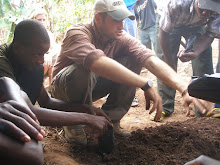
My good friend Sarah Stance is doing her Master's degree at Stellenbosch University in South Africa, and recently asked me to give her my perspective on Social Change as a Peace Corps volunteer in Malawi. As it turned out I ended up talking mostly about my friend Benidicto Gondwe who I have pegged as a "posative social deviant". So I thought I'd share what I wrote to her, because it shows the cream of the crop of the people I work with in Mwazisi. People like Benidicto are the ones that make me feel so lucky to be doing what I'm doing.
In my experience as a Peace Corps volunteer in Malawi social change needs positive social deviants to initiate the shift in thought. Somebody who is willing to break away from the crowd and try something different. I would summarize most change that I have seen as follows: it starts with an original positive social deviant or even a group of social deviants who first question the way everybody around them is doing things or sees the world. After realizing that something needs to change, the social deviant starts putting a better way into practice for themselves. Sometimes doing things different can cause a person to be isolated from their peers, but if they stick to their idea they start setting an example for the people who have ridiculed them. The change really starts to happen when people see the success of the original deviants and start adopting the new idea. The more examples start to crop up the more people see the benefit of the change and adopt it and the idea snowballs from there. Eventually the change becomes the norm and anybody who does things the old way is the social deviant.
As Peace Corps volunteers our job is essentially to become just another member of the community and try to be that positive social deviant. Unfortunately that isn’t as realistic as I hoped because no matter how long I am here, and how hard I try, I will never be just another member of the community in this rural Malawian village. To think that eventually I will blend in and be seen as something different then the Azungu would be just deluding myself. I will always be different and I can deal with that. The problem is that I can’t be a positive social deviant when I am coming in as a very strange outsider. Anything that I do that is out of the ordinary is simply dismissed as the madness of the crazy Azungu by most people.
It takes the communities own innovators who are willing to give new ideas I try to initiate a try to initiate the real change, often times adding their own ingenuity to improve on it. My friend Benidicto Gondwe is a great example of one of those necessary social deviants. With out Benidicto I don’t think I could have been effective in initiating any new ideas here
I can’t say that in my two years I have seen any significant change in the communities behavior or way of thinking towards environmental issues, which is what I am here to work on. But I have seen small shifts in a variety of aspects of life in the village, from the way people garden to where they try to earn their money from. I hope that these small shifts in daily life add up to be an overall change in mentality towards the local environment down the road.
One specific example of a small shift is beekeeping. From the very beginning of my service I have been trying to encourage as many people as possible to take up beekeeping. It’s a very profitable business for the community and it’s a fantastic way to protect the existing trees that the hives are hung from. I encourage Kenyan Top bar hives made from timber planks instead of the local hives which are made from a hollowed out tree trunk. The plank hives are far less destructive to produce, and they are a far more efficient way to manage the bees.
Most people say they would prefer to have the plank hives but they are too expensive. So I tried to present ways to make the same hive less expensive. I used a design from the Nkhata Bay Small Beekeepers Research and Development Association to build a top bar hive that had split bamboo on the sides instead of planks, then I plastered over the spaces with mud. This design used less than a quarter of the amount of planks needed for regular plank hives, but the hive was far too heavy to carry up the mountains to hang. Benidicto still saw the merit in the design of the hive, and used the same design to make a hive that was plastered with paper-mache made from soaked waste papers mixed with cassava flour as a glue. His hive was much lighter, and once dry less susceptible to cracking. The community really took to his design and lots of people helped in constructing many more that have all since been sold or hung. But it first took Benidicto’s openness to try a different idea that everybody was closed to for him to bridge the gap and make my idea useful for a larger group of people.
Another example of gradual changing mentalities is mulching a garden during the dry months in order to hold in the grounds moisture. The year before I started my river valley garden I noticed that absolutely nobody put mulch on their garden. The next year when the farmers in the gardens next to mine saw me mulching my vegetables, they said “you will invite termites and other insects that will attack your vegetables.” Of course the opposite was true, mulching kept the ground around my vegetables constantly moist, and therefore made for strong resistant crops. While the others had problems with pests, because their vegetables quickly dried out and were unhealthy. Again my friend Benidicto was one of the first people to take up the idea. He chopped up Sugar Cane waste grasses and put them all around the base of his tomato plants. He bragged that one heavy watering once a week was enough to keep his tomatoes watered for the whole week.
Benidicto is a great example o a positive social deviant , he is constantly looking for new and better ways of doing things. In addition to the previous examples I can say that he was the first person in Mwazisi to start using a treadle pump, to plant sunflowers in the rainy season, to start growing climbing vines on his house to make it cooler in the hot months, and many other things.
I’ve seen him laughed at and made fun of for being different pleanty of time but he always smiles, shrugs his shoulders and says “We shall see.” Often times people see that he was right, and that’s when they start making changes. It takes somebody like Benidicto to first be willing to be different and try something that might not work to pave the way for change. I may not be the great social innovator that I hoped to be when I first joined Peace Corps, but I am happy to keep feeding ideas to Benidicto and see where he can run with them, without him and people like him I can’t imagine how ideas would evolve in Mwazisi.
Wednesday, August 19, 2009

Sunday, August 9, 2009
Project: Mwazisi Beekeepers Workshop
This past week we held our first serious Mwazisi beekeepers association training. The idea for the training came to me when a friend of mine from USAid gave me a set of instructional beekeeping videos in Chichewa. The videos were produced by an NGO called Compass 2 that were trying to provide Malawian beekeepers with technical training to build the business country wide. It’s over six hours of videos explaining how to build a top bar hive, the equipment needed, transferring from traditional hives, colony management and division, harvesting, processing, and business.
 |
| Bwana Mgogoninga left, Nya Soko middle, Bendicto Gondwe right |
 |
| Toking notes on mogogninga's lecture |
By the time I get back a few of the participants are waiting with Mgogoninga. I let them in and try to set up the laptop to occupy them with the introduction video while we wait for others to come. I run up to Benidicto's house, who's also supposed to teach a few sessions. By the time I get back I find there are about 15 participants, and Mgogoninga has started teaching. When I ask why they stopped the video, they say there is no power…I'm baffled, I made sure nobody used the battery over the weekend, so that the batteries would have a chance to get a full charge. It takes me about twenty minutes of trying different converters, and fiddling with the invertor before I figure out that students plugging in their cell phone chargers in the next door classroom has shorted out the system. So finally I am able to start the video on hive construction.
 |
| Bwana Mzito teaches participants on how to build a top bar, |
In the afternoon we baited one of Mzito's hives, and took a little field trip to hang it on a nearby mountain. Our last lesson is a disscussion about the way forward in Mwazisi. We decide that it's best for everybody to remain in their family groups or small local clubs of 10 or so people, and work on getting up to ten occupied hives per person. The Beekeeper's association is more of an informal gathering where we can share information, and bulk all of our honey so that processors can buy it larger quantities. We manage to finish the last video around 5:00pm .
Friday, July 3, 2009
Back in Mwazisi
After being away for close to two months I was actually a bit nervous about going back to Mwazisi. Would people feel like I had abandoned them and left all of our projects hanging in the air while I went to go play on bikes in Mozambique? I felt a streak of my families catholic guilt, for leaving so much of my work unfinished for so long. But actually it was the perfect time to take a break. I wouldn't have gotten anything done while everybody was busy bailing and taking their tobacco to the auction floors. The Agriculture office construction is on hold while we are waiting for money from the department of agriculture so we can install the window frames.
I felt stupid for worrying about coming back because everybody welcomed me back with warm smiles and open arms. It feels a bit like coming home, being surrounded by familiar people and places again. Everything just feels good, the genuine glow in peoples eyes when they say “Machona Danny” (You've been missing). It doesn't feel like a guilt trip, but instead a sincere concern for when I'd be back. There were a lot of rumors that I had decided to leave and go back to America, because I was frustrated with the holdups in all of our projects. But others knew I would be back, and quelled rumors. I am happy to have proved them right, and came back energized and anxious to get back to work.
I was happy to find things pretty much as I left them. The pond is still full, and fish are healthy. The trees we out planted have grown significantly since I left. For the first week it felt like everything was a rediscovery; running up the hills that lead down to Mwazisi at sunrise; the ear to ear smile on the face of Sara (my favorite mandazi lady) as she greets me with her best American impression “HI DAN!”; all of the other women selling tomatoes and dried fish trying to keep up their stony faced aloof persona, but eventually relenting a smile to my broken Timbuka teasing; sitting on my front porch eating peanuts and chatting with my best friends Kavisepo and Benidicto; and the satisfied fatigue as I walk back from a good days work in the garden chewing on sugar cane at sunset. I didn't realize how I missed my daily routines until I rediscovered them.
I've also rediscovered all my old frustrations as well: no show meetings, the trapped aggravation every time a drunk corners me into a conversation on the street, being the only person who shows up to work on a project that is supposed to be a group project, the endless delays and lost paperwork that I deal with every time I go to town to try and work through the bureaucracy, the general disorder that makes getting anything done seem impossible.
Then whenever I get to my wits end with frustration, somebody always seems to go above and beyond to help me or do something nice for me, which makes me feel silly for being so dang pissed off. I guess you need those frustrations and low points to fully appreciate the good things. You need a drunk to call you an azungu and demand your money, in order to be astonished by the hungry kid on the matola who offers to share his greasy bag of chips with you.
Monday, May 25, 2009
Inhambane and Surfing Tofo Beach
From Masinga we rode to Maxixe where we loaded our bikes on a dhow to cross the bay to Inhambane. We had the sun setting behind us and a nearly full moon rising over Inhambane cityin front of us; a beautiful setting for the slow calm boat ride across the bay. We checked into a Pensao after sunset and found a little seafood restaurant where I had a huge Barracuda steak. We took a walk around Inhambane's empty streets afterwards. It's a really nice sleepy waterside city with a mixture of modern garden lined avenues and old colonial style architecture. I was amazed how clean and well kept the city was. It was probably the most well developed and well cared for small city I have seen in the past two years.
It's also a city full of history, as one of of Mozambique's oldest coastal towns. The next morning we checked out a little cultural and city history museum. Apparently Arabic traders started coming to the area as early as the 11th century for the textiles, and by the time the Portuguese arrived in the early 16th century it had a very well established cotton spinning industry. I think this early exposure to outsiders might explain why Southern Mozambique seems so much more developed than the North and other countries more inland. By the mid 1800's Inhambane became a primary port for exporting Ivory and then slaves. Soon 1500 slaves were passing through its ports every year; a really dark chapter in the areas past, but also the time when it was most thriving. The slave trade is what made Inhambane into one of the biggest ports in Mozambique at the time, but with abolition Inhambane began it's gradual decline which increased dramatically when Maputo passed it up as the main trade hub. Now Inhambane has become a really charming quiet little city, but Wiz made the prediction that in a few years it's going to become a huge tourist draw like Zanzibar.
From Inhambane we rode to Tofo beach. We were excited to go there for diving, but I was a little disappointed because it was such a different experience than our nice chill dive with Denis in Vilanculos. Tofo is a big destination for divers to come and see big stuff like whale sharks and Manta Rays. Unfortunately on our dive we didn't see either and I felt like it was a dive factory. They were just getting as many people down to the reef as possible and back up to get their money. Although the dive became worth it for me because of another awesome encounter with a loggerhead turtle. I saw his massive shell coming towards us from about 15 meters away in the dark. Wiz must have been right when he said turtles are attracted to him because the turtle literally swam right through the middle of us. I think it would be more accurate to say the turtle was attracted to me though, because at one point it veered off of it's course and swam up and over my shoulder. I tried to remember to breath as my heart stopped and I stayed perfectly still to try to not scare him away. That was enough to make the dive worth it, but we decided not to take any more. Scuba Diving is an awesome experience, but unfortunately I think its a bit too expensive of a sport for me to do much of.
Surfing on the other hand is much more up my alley and apparently we were in the right place for it. We were camping at turtle cove, which is a big surfer hangout. The characters we met there completely fit the image of surfing that I have in my surfer wannabee head. The most unforgetable character was a man named Bruce Gold; an old time surfer that looks like a cross between Gandolff the Wizard and one of the Beach Boys. He always keeps his long beard tied in a knot under his chin and dawns a tattered straw cowboy hat that makes him look even more gandolffish. He and his friend Shawn were in a big tent across from ours. They had clearly been staked there for an extended period of time. I later found out that Shawn was actually traveling with Bruce to film him for surf movies...apparently Bruce has quite a following of fans who live vicariously through him by watching his surf adventures on a website called "live the life". He was never around during the day obviously because he was chasing swells, but at night he could ussually be found reading by candlelight in his tent or blending bizzare mixtures of food into super meal drinks.
One night I went over to talk with him while he had dinner. He was drinking a solution of ground up legumes mixed with ginger, honey, coconut milk, and some other things that I missed in his South African accent. Wiz and I were preparing to go out to a full moon party on the beach, so I had a bottle of Tipo Tinto (cheap local rum) that he took a cap full of and mixed into his concoction. While he told me some stories about the surfers that had rolled through his hometown of Richards Bay, he sipped on his dinner and chomped on a bread roll that made his beard swing back and forth between sentences. Most of the time though Bruce just wanted to hear about our bike trip, and what I was doing in Malawi. He was really excited to hear that I am beekeeping in Malawi. He wanted to know all about what the different honeys tasted like based on what flowers they were pollinating, and generally about bee behavior. He was an interesting guy to talk to and incredibly modest. When I left I told him that I have only surfed a handful of times a couple years ago but I had a blast once I got up and am really eager to surf some more.
Sure enough the next morning Sean was outside my tent bright eyed and bushy tailed calling me to go surfing. I had a late night at the full moon party, so I was a bit less than enthusiastic, but I didn't want the to miss the opportunity to surf with these guys, so I downed as much water as I could, ate a fried egg and hopped in the back of their truck to go out to Tofino beach. I had only surfed 3 times before and that was three years ago in Ireland, so it took a while to get the hang of it again. Bruce and I stuck together making a circle taking turns paddling out and against the rip tide then paddling into a wave. He watched me and yelled out advice; "get your nose down into the wave," " when the wave grabs you get your weight back and let it pull you." When it was his turn to catch a wave, I watched with amazement how smoothly and easily he paddled into every wave. When I said that to him, he grinned and said "I paddle with intention!"
I took my fair share of complete wash-outs, but after a while I really started to get the feeling. My paddling got more efficient and I could get up and ride the waves all the way back in. The more I got the hang of it, the more addicted I was and the more stoked I was to paddle back out and catch another. The feeling of the wave grabbing you, and pulling your board is an unmatchable sensation. I can see why it's so addicting. I can also see why so many people idolize Bruce. He's found his passion, and he lives it every day. I would definitely say that he is "living the life."
The End Of a Great Ride
From Tofo we rode down the Inhambane peninsula where we stayed with Anthony a health volunteer from New york. He fed us spaghetti and we got a good night sleep before riding about 90 km to Quisicco to stay with another Peace Corps teacher named Molly. Molly is a biology teacher living in probably one of the most beautiful peace corps sites I have ever seen. She takes her morning swim in a series of large fresh water lagoons next to her school. She lives in a nice little house next to the catholic church. Her yard is full of exotic plants and well kept gardens. We ate our dinner out in her garden patio, while we listened to the church choir practice next door; a great way to enjoy our meal.
The next morning we got our earliest start yet, we were able to cover 140 km despite having to stop to patch a flat tire, and replace two more broken spokes. That was our longest day so far, which was good preparation for the day I was planning for myself the following day. Wiz decided he was going to spend an extra day in Xai Xai and take a bus to Maputo because our allotted time in Mozambique was nearing an end, and we both wanted to have a couple days to enjoy the big city. I agreed we needed to get to Maputo, but decided I wanted to give myself one more big challenge to cap off the bike tour. That night we stayed with Zach our last and most mind blowingly generous Peace Corps host of all. From Zach's house in Changuen to Maputo was bout 225km...85 km longer than our longest day up to that point. My plan was to leave at four in the morning, pack a lunch, and ride all day to get to Maputo before sun down. If I didn't make it, I knew Peace Corps volunteers that lived just before the city limits I could stay with. So the night before I greased my chain, patched my spare tires, and got my rear tire as true as I could get it. I made three peanut butter and honey sandwiches and loaded up my saddlebags before getting to bed early.
That morning I actually woke up a half hour before my alarm was supposed to go off at 4:00 am, and was actually spry enough to start riding early. I rolled out of chenguen with a beanie and a headlamp stuffed under my helmet into the cold dark quiet. The sun hadn't even rose yet and I had been riding for over an hour when I got my first flat tire just outside of XaiXai, but I was able to patch it fast and get back out on the road by 6:00 am. I stopped on a bridge to take some pictures of the sunrise over the Limpopo river.
The warmth from the first glimmers of sunlight energized me. The shoulder was wide and there were almost no cars on the road so I started listening to my I-pod. I found myself in a rhythm and everything seemed to be working in harmony, my leg muscles were in direct unison with the bikes gears, and my tires glided over the smooth pavement just like they were set on rails. I must have kept an average speed of over 25 mph for over 2 hours. I didn't feel any fatigue, the music bumping in my headphones seemed to surge directly into my legs and my peddles pumped in harmony with the flying violins, and piano of the Amalie soundtrack, or the bumping hip hop beats of Blackalicious. Before 10:00am I realized I was almost to Macia which is over a third of the way to Maputo, I was way ahead of where I thought I would be and I still felt great.
When I got to Macia I realized that I broke two more spokes. I decided to take a break and fix them while I had access to a good pump. I didn't want them all to start going out on me while I was out in the middle of nowhere. I put in the new spokes and gobbled two sandwiches and got back out on the road by 10:30. I got back up to a good pace again and had been riding for about an hour when I blew my rear tire Again!! Damn! I was absolutely in the middle of nowhere, and cursing up a storm. While I was taking my tire off a very kind Mozambican lawyer named Helder stopped and offered me a ride. He could throw my bike in the back of his truck, and he was going all the way to Maputo. The cyclist in me wanted to patch my tire and press on, but not bad enough to trump the Peace Corps volunteer in me that couldn't pass up such a dream hitch. It turned out to be the right decision; Helder was the most shining example of Mozambican hospitality that I encountered the whole trip. Not only did he drive my bike and I all the way to Maputo in his brand new truck, but when we got there he took me to his favorite seafood restaurant for lunch and even took the time to drive me around and give me a quick tour of his beloved home city.
In the end I didn't achieve my big 200km epic day, but I wasn't too broken up about it. We weren't really riding for the bragging rights. We rode our bikes through Mozambique because we wanted to see the country at our own pace, unbeholden to any pushy minibus drivers, or unreliable bus schedules. Also you see a place in an entirely different way when your traveling through it on a bike. You can make eye contact and share a smile with the people you pass along the way. Not every encounter was so rosy; there was the obnoxious drunks screaming for money, or the ill-mannered teenagers entertaining their friends by calling us Mulungu. But those encounters were far and few between when compared to the good ones. The good encounters I won't forget:
Another great benefit of biking was the feeling I felt that morning. I guess you could call it a bikers high. The feeling when everything just clicks and peddling no longer feels like a labor, but a rush. I've had similar feelings on the football field or basketball court; where you no longer feel like you need to think before your muscles act, your legs just fly beneath you, and every tackle or shot just feels effortless. It's the same feeling the writer has when the words just seem to write themselves, in one flowing stream of thought to pen. Or for the musician who's melody just comes pouring out of their instrument in perfect tempo and rhythm. It's the feeling of life flowing at you and being fully in the moment. I never thought I'd get such a high from riding a bike, but I felt it that morning with palm groves whizzing by and birds cruising along on my pace, I felt as alive as I've ever felt...and it felt good!
Our last few days in Mozambique were spent enjoying Maputo with great people. After two years of being a huge spectacle in a small African village it was really nice being anonymous in a big city. Zach and Ali came to town with us to play host, and they were awesome at it. During the day I entertained myself riding my bike up and and down busy streets named after communist leaders from around the world (Rua de Mao Ze Dung or Karl Marx Boulevard). I felt like a bike messenger trying to keep up with the flow of traffic, weaving around buses, and dodging opening car doors. I saw many of the museums and tourist sites by biking during the day. At night we were in Zach's hands, which is good because the man has his thumb on the pulse of Maputo's social jugular. We went to all night open air dance parties in backwater alleyways, drank beers and rode bumper cars with the dutch ambassador, and made friends with cool and interesting people all along the way.
I would have loved to have spent a few more days in Maputo, or even continued on with Wiz to South Africa, but riding through Mozambique took longer than I thought, and my vacation time was finished. I have a garden to tend to in Mwazisi, and I'm ready to get back to my home away from home. My last night in town a British ex-pat approached me, and said she heard I had a bike I might be willing to sell. I hesitantly acknowledged that I did. The purple people eater and I had been through a lot together, but it was silly to haul it back to Malawi especially when she was offering to buy it for the exact same amount as I bought it for. When the bike was sold the trip was officially over. I hugged Wiz goodbye, and got on a 4:00am bus that took 36 hours to get back to Tete. I crossed the border just in time to see Malawi celebrating a peaceful and successful election. It was a great trip, and Mozambique has etched out a big place in my heart, but it's really nice to be back in Malawi. After my first official vacation since starting as a Peace Corps volunteer I feel recharged and ready to dive back into my work.
The next morning we got our earliest start yet, we were able to cover 140 km despite having to stop to patch a flat tire, and replace two more broken spokes. That was our longest day so far, which was good preparation for the day I was planning for myself the following day. Wiz decided he was going to spend an extra day in Xai Xai and take a bus to Maputo because our allotted time in Mozambique was nearing an end, and we both wanted to have a couple days to enjoy the big city. I agreed we needed to get to Maputo, but decided I wanted to give myself one more big challenge to cap off the bike tour. That night we stayed with Zach our last and most mind blowingly generous Peace Corps host of all. From Zach's house in Changuen to Maputo was bout 225km...85 km longer than our longest day up to that point. My plan was to leave at four in the morning, pack a lunch, and ride all day to get to Maputo before sun down. If I didn't make it, I knew Peace Corps volunteers that lived just before the city limits I could stay with. So the night before I greased my chain, patched my spare tires, and got my rear tire as true as I could get it. I made three peanut butter and honey sandwiches and loaded up my saddlebags before getting to bed early.
That morning I actually woke up a half hour before my alarm was supposed to go off at 4:00 am, and was actually spry enough to start riding early. I rolled out of chenguen with a beanie and a headlamp stuffed under my helmet into the cold dark quiet. The sun hadn't even rose yet and I had been riding for over an hour when I got my first flat tire just outside of XaiXai, but I was able to patch it fast and get back out on the road by 6:00 am. I stopped on a bridge to take some pictures of the sunrise over the Limpopo river.
The warmth from the first glimmers of sunlight energized me. The shoulder was wide and there were almost no cars on the road so I started listening to my I-pod. I found myself in a rhythm and everything seemed to be working in harmony, my leg muscles were in direct unison with the bikes gears, and my tires glided over the smooth pavement just like they were set on rails. I must have kept an average speed of over 25 mph for over 2 hours. I didn't feel any fatigue, the music bumping in my headphones seemed to surge directly into my legs and my peddles pumped in harmony with the flying violins, and piano of the Amalie soundtrack, or the bumping hip hop beats of Blackalicious. Before 10:00am I realized I was almost to Macia which is over a third of the way to Maputo, I was way ahead of where I thought I would be and I still felt great.
When I got to Macia I realized that I broke two more spokes. I decided to take a break and fix them while I had access to a good pump. I didn't want them all to start going out on me while I was out in the middle of nowhere. I put in the new spokes and gobbled two sandwiches and got back out on the road by 10:30. I got back up to a good pace again and had been riding for about an hour when I blew my rear tire Again!! Damn! I was absolutely in the middle of nowhere, and cursing up a storm. While I was taking my tire off a very kind Mozambican lawyer named Helder stopped and offered me a ride. He could throw my bike in the back of his truck, and he was going all the way to Maputo. The cyclist in me wanted to patch my tire and press on, but not bad enough to trump the Peace Corps volunteer in me that couldn't pass up such a dream hitch. It turned out to be the right decision; Helder was the most shining example of Mozambican hospitality that I encountered the whole trip. Not only did he drive my bike and I all the way to Maputo in his brand new truck, but when we got there he took me to his favorite seafood restaurant for lunch and even took the time to drive me around and give me a quick tour of his beloved home city.
In the end I didn't achieve my big 200km epic day, but I wasn't too broken up about it. We weren't really riding for the bragging rights. We rode our bikes through Mozambique because we wanted to see the country at our own pace, unbeholden to any pushy minibus drivers, or unreliable bus schedules. Also you see a place in an entirely different way when your traveling through it on a bike. You can make eye contact and share a smile with the people you pass along the way. Not every encounter was so rosy; there was the obnoxious drunks screaming for money, or the ill-mannered teenagers entertaining their friends by calling us Mulungu. But those encounters were far and few between when compared to the good ones. The good encounters I won't forget:
-Passing by a waving smiling group of children, and making them squeal with joyThose are the encounters that are most important, and they certainly wouldn't have been as frequent if we were traveling by planes, trains, or automobiles.
as I let go of my handle bars to give them a two-handed wave.
-Flashing a smile and a hang loose sign at the slack-jawed starring boy, to remind him that he is actually looking at a human being, which he responds to with a giant
grin and an enthusiastic thumbs up.
-Seeing the appreciation on an old women's face when I slow down to tip the brim of my bike helmet like a cowboy hat, and show my respect with a “Bon Dia Donna.”
Another great benefit of biking was the feeling I felt that morning. I guess you could call it a bikers high. The feeling when everything just clicks and peddling no longer feels like a labor, but a rush. I've had similar feelings on the football field or basketball court; where you no longer feel like you need to think before your muscles act, your legs just fly beneath you, and every tackle or shot just feels effortless. It's the same feeling the writer has when the words just seem to write themselves, in one flowing stream of thought to pen. Or for the musician who's melody just comes pouring out of their instrument in perfect tempo and rhythm. It's the feeling of life flowing at you and being fully in the moment. I never thought I'd get such a high from riding a bike, but I felt it that morning with palm groves whizzing by and birds cruising along on my pace, I felt as alive as I've ever felt...and it felt good!
Our last few days in Mozambique were spent enjoying Maputo with great people. After two years of being a huge spectacle in a small African village it was really nice being anonymous in a big city. Zach and Ali came to town with us to play host, and they were awesome at it. During the day I entertained myself riding my bike up and and down busy streets named after communist leaders from around the world (Rua de Mao Ze Dung or Karl Marx Boulevard). I felt like a bike messenger trying to keep up with the flow of traffic, weaving around buses, and dodging opening car doors. I saw many of the museums and tourist sites by biking during the day. At night we were in Zach's hands, which is good because the man has his thumb on the pulse of Maputo's social jugular. We went to all night open air dance parties in backwater alleyways, drank beers and rode bumper cars with the dutch ambassador, and made friends with cool and interesting people all along the way.
I would have loved to have spent a few more days in Maputo, or even continued on with Wiz to South Africa, but riding through Mozambique took longer than I thought, and my vacation time was finished. I have a garden to tend to in Mwazisi, and I'm ready to get back to my home away from home. My last night in town a British ex-pat approached me, and said she heard I had a bike I might be willing to sell. I hesitantly acknowledged that I did. The purple people eater and I had been through a lot together, but it was silly to haul it back to Malawi especially when she was offering to buy it for the exact same amount as I bought it for. When the bike was sold the trip was officially over. I hugged Wiz goodbye, and got on a 4:00am bus that took 36 hours to get back to Tete. I crossed the border just in time to see Malawi celebrating a peaceful and successful election. It was a great trip, and Mozambique has etched out a big place in my heart, but it's really nice to be back in Malawi. After my first official vacation since starting as a Peace Corps volunteer I feel recharged and ready to dive back into my work.
Sunday, May 24, 2009
Chimoio, Vilanculos, and Partying with Peace Corps Moz
From Gorongosa we made a little detour to Chimoio to meet up with the dynamic duo from Dedza: Rob and Jason. We knew we wouldn't catch them on the coast because they were passing through Mozambique faster then us...obviously we're on bikes! But it was real nice spending a few days kicking around Chimoio's streets with old friends from Malawi. Chimoio was a really charming little city with Portuguese style cafes and theatres mixed with your usual crazy African Markets. We had a lot of wandering around the street markets and playing against the locals on the curb side Foosball tables.
The following day we knocked about 400km out of our trip, by loading our bikes on a bus to Inhassoro where we got our first glimpse of the Indian ocean. From there we rode to Vilanculos, but I had my first major bike problem along the way. The weight of my saddle bags started causing spokes to start breaking on my rear tire. I was cursing my head off because it was getting late, we were in the middle of nowhere, and I didn't have any spare spokes or a spoke wrench, but I was saved by the kindness of complete strangers. A trucker picked me up and brought me to the next town where I found a bike parts stand, when a guy saw me offload my bike, he asked me what was wrong? When I showed him my broken spokes he ran off and came back five minutes later with his friend a bike mechanic who had a spoke wrench. In no time he had new spokes in and the tire trued. Since the sun had already set, the owner of the bike shop offered us a room in his house. His family took good care of us feeding us and giving us a warm bucket bath. Unfortunately the problem of breaking spokes persisted, but with repetition I got better at replacing them and truing my tire. It seemed like all of our breakdowns were chances to see Mozambicans at there most generous...I was amazed how much everybody wanted to help us when we were at our most vulnerable. I certainly won't soon forget the kindness of the people of Pambarra.
Vilankulos was the tropical beach paradise that we were waiting for with it's long white beaches lined with beched dhows and palm trees. The beaches are a short dhow ride away from the Archipelago of Bazaruto; a string of islands and reefs that make up the WWF protected Bazaruto National Park. We went out to the Islands with a French dive master named Denis to dive on Two Mile reef. It was full day excursion; we did two long dives and rode around in the afternoon checking out dolphins and dugongs (a rare sea mammal, like a manatee). The Islands themselves were amazing, We climbed the biggest sand dune to see the whole island. The half of the island that we landed on was nothing but fine white sand stretching into the bluest clearest water I have ever seen. On the other side of the dune was dense green tropical forests beaming with life. It was the type of Island that I thought only existed on TV or in pictures.
The diving was also amazing. The visibility was crystal clear and the reef was beautiful. Diving is still very new to me so the sensation of just floating through the alien world under the sea with the sound of my own slow breathes in my ears is still a very cool and meditative feeling for me. So when you mix that with the bizarre and beautiful wildlife of the reef it seemed like a very lucid fantastic dream to me. Swimming trough schools of bight colored butterfly and angelfish, the moray eels creeping out of their holes in the reef to give us a silent hiss, realizing that the rock i am swimming over is actually a giant camouflaged potato grouper longer and much thicker than my leg as the big fish lifted up from the ocean floor startled by my bubbles, watching two big devil rays glide out into the deep blue, poking around the reef to spot lionfish and scorpionfish with their dangerous but decorative quills. My favorite was the two massive sea turtles that glided passed us with grace and ease. They were like the wise old Buddhas of the reef. They slowly paddled through the water with no particular panic or rush wearing their collection of barnacles to show their seniorty.
We stuck around Vilanculos for the weekend because we knew all of Peace Corps Mozambique would be descending on Baobabs for the annual beer olympics. It was a battle between the Southern Saboteurs, and the North/Central 24 hour warriors. The 24 hour crew adopted us because we are in Malawi, and that's practically central Mozambique. The events included dizzy bat, flip cup, slosh ball kick ball and shotgun beer duel. By the time the games got finished everybody lost track of the points, and the southerners managed to steal the trophy, so they were declared the winners. It was nice seeing that Mozambique volunteers get together occasionally, to blow off steam the same way we do in Malawi. We had a lot of fun hanging out with them, and ended up dancing through the night at Baobab's bar. Many of us went back down to the water late night to cool off and were in awe when we realized that there was photosynthetic plankton that made little glowing tracers with every movement in the water. It was asureal ending to a great night spent with good people.
One of the great consequences of sticking around for the party is that we met a whole lot of people that lived all around the country, and we could stay with throughout the rest of our trip. In fact our next two stops were with volunteers. First we stayed with Rachel and Amy two teachers at a mission in Mappinani. They stuffed us with chicken soup, and avocado salad. The next day we stayed with Patrick who is teaching English and art at a World bank school in Masinga. He made us a killer chicken curry. Every peace corps volunteer looked at our visit as an excuse to cook a special meal. We generally provided a bit of wine or chocolate as a thank you for the great hospitality. An awful small price to pay for such wonderful accomodation and company.
Saturday, May 2, 2009
Mount Gorongosa
Climbing Mount Gorongosa was at the top of our to do list since reading about all of the mythology associated with it, but it proved to be much more difficult even to find somebody who would guide us to the mountain. But the whole process turned into a great adventure.
After a couple days of asking around Gorongosa town and the national park we finally found Montinho, a wirey soft spoken young man, who was 20 years old but looked more like 15. He turned out to be a great guide, and quickly became our friend. Montinho told us that we had to go visit the chief to get permission to climb the mountain before we went, and that we also had to buy supplies for the chief to perform a ceremony to bless our journey. He needed two meters of black and white cloth, a bag of leaf tobacco, 2 packs of cigarettes, a box of matches, a jug of wine, and a bottle of rum. Sounds like a hell of a ceremony, I guess the Regulo has to have a party in our honor before we hike. The chief was named Regulo Canda, and he seemed like a good guy, although a bit hung over. I was disappointed he didn't share any of the booze, but before we left he pointed to the mountain with a smile and said paridiso, which made me really want to get up there.
We rode our bikes about 27 km to actually get to the mountain. We left our bikes at a base camp at the foot of the mountain, and cooked lunch before we started hiking. I was glad the no shoes rumor was bogus because the grass was so tall and the trail was so overgrown that I couldn't see my knees let alone what was under my feet. but it was a beautiful hike through the golden grass meadows at sunset. We arrived to a dense forest just after sundown, and set up our tent there for the night.
The next morning we got to see just how beautiful the forest actually was. It was much denser than most of the forests I've seen in Malawi, and Wiz said it actually reminded him of the rainforests in Hawaii. It seemed like there was life absolutely everywhere, all interweaving and climbing over each other Some of the trees must have been hundreds of years old because they were massive, and looked all the more ancient because all of the layers of vines growing over them. It was a bit of a slippery walk over the wet logs, and moss covered rocks. The forest went all the way to the top, and then seemed to stop abruptly at the top of the mountain.
The top was actually a massive plateau with wide open grass meadows and clouds that were right on top of the grass pushing across the field through to the distant peaks. We climbed the the nearest peak to us, which was the highest and had a radio antenna on top. The last section got real slippery and sketchy with big cliffs on all sides, so that was the only section that I did barefoot. There was a watchman living at the top living with his family. I found there secluded lives up there fascinating, kind of like an old man living up in the lighthouse. It would take a very content soul to live that life, and certainly seemed that. He had a warm welcoming smile, and he leisurely walked up to the top with us. We shared a few bread rolls with peanut butter and honey with him as we lingered to enjoy the view. A couple times the wind pushed some holes in the clouds beneath us so we could just how far we had climbed. It was magnificent!
We climbed down the other side which was an even denser forest. The trees weren't as tall but it was much bushier, so it seemed like the trail was a tunnel bored straight through the forest. That was a long steep down hill hike, but the reward came at the end with a huge three tiered waterfall. We took a long break there to climb around on the rocks and play around in the mist.
Then we rushed to get back to our bikes before it got to late. We ripped down the dirt paths on our bikes racing the sunset, and got back to the tarmac road just after dark. The last eight km on the smooth road were very welcome after the long day we had. We stayed with Jared and Tara a Peace Corps couple in Gorongosa, and shared the stories from our hike over a hearty pasta meal. We were surprised when they told us that they nor any other Mozambique volunteers still hadn't climbed the mountain yet, which made us feel all the more proud of having checked it off our list.
Subscribe to:
Posts (Atom)