Friday, February 8, 2013

Thoughts on life and death in Africa

I actually wrote this during one of my first few sleepless nights of jet-lag when I got into country.  But I had to find time to edit some of the deliriousness out of it.

When I look back at my last blog from Malawi, it was about three months before I wrapped up my Peace Corps service and I wrote mostly about trying to savor the sights, sounds, smells, and emotions that went with life in Africa.  I don't know why I stopped posting blogs during my last three months, maybe I couldn't find the right words to verbalize the emotions that went with all of those goodbyes.  The goodbyes weren't just with the people I loved in Malawi, they were also with the day to day life in Africa that I had become so accustomed to.   A lifestyle that swung me back and forth on the biggest emotional roller coaster ride of my life.  I don't know if it was a life that I would say I particularly loved, but it was a life that I have genuinely missed in the time that has elapsed.

Almost in the instant that I stepped off of the plane in Uganda everything came rushing back to me, along with similar sights and sounds, came a deep nostalgia for the life I knew in Malawi.  Something about life here makes me feel more alive than any other place I have ever been.  Granted I haven't been a lot of places,  maybe life has a similar feeling in parts of India or Latin America, but my only experiences with widespread poverty are in Africa so I associate these feelings with Africa.  Other outsiders share a similar feeling, I ran across a line by Lance Morrow an essayist for Time Magazine that seems to articulate what I'm trying to get at:
"Africa has a genious for extremes, for the beginning and the end. It seems simultaneously connected to some memory of Eden and to some foretaste of apocalypse. Nowhere is day more vivid or night darker. Nowhere are forests more luxuriant. Nowhere is there a continent more miserable."  
I would add another line; "Nowhere is a continent more joyful."  I think Mr. Morrow is getting at the same sentiment that I am, life in Africa is more primal, more harsh, and all at once more beautiful than anywhere else I have been.  I would also say that the misery that he mentions seems to always be juxtaposed with pure hapiness.  The same woman who wails in misery at her niece's funeral,  might be laughing with equally as stirring laughter the next day as she shares a memory with a sister.  Golda Muir once said "those who can't cry with all of their hearts, also can't laugh with all of their hearts."  This is true in Africa, people tend to do both with absolutely every piece of their heart.

Maybe this capacity for extremes comes with always being in such close proximity to death.  Death seems to be lurking around every corner.  Whether its careening down a hill through a city in a minibus - full to capacity - weaving around traffic in and out of the lane of oncoming traffic - just barely missing pedestrians and bike taxis that line either side of the road,  or walking through the bush to harvest from a distant hive and coming around a corner to find a bull elephant - ears flapping - and eyes red with fury for your intrusion.  Maybe it's a neighbor who was nearly bitten by a black mamba before chopping it's head off with a Jembe, or a different neighbor who just lost his second child to Malaria.  It could be the millions of adults dying of aids across the continent or the millions of children dying of hunger, death is always lurking somewhere around.  But still life goes on in every community, and so does laughter, dancing, celebration with nothing held back.  That is part of what I love most about Africa, this capacity for joy despite misery.

I have been thinking about this since I had a conversation with my good friend from Mwazisi Benedicto, after three years of not being able to get through to him.  I have mostly been trying to call him for the past year, ever since I found out that his wife Dorothy had died.  My friend Prashanth who replaced me in Mwazisi told me that she had some sort of infection that appeared on her leg.  She went to the health clinic straight away.  They didn't know what was causing it so they organized transport to the Rumphi hospital for the next morning.  She died before the morning came.  People still don't know what caused her to die.

I know that Benidicto must have been devastated.  I know this because of the way he talked about her.  When he introduced me to her he said "So Daniel, this is my wife."  "Wow, Benidicto she is really beautiful," I said.  The way he looked at her and smiled said it all as he just said, "Yes, I know."  He constantly bragged about her hard work in the community and talked about her as his companion, which is rare in such a male dominated society.

When I spoke to him on the phone a couple weeks ago I struggled to figure out what to say about it.  We talked about the village, various agriculture projects he was working on, my life in New York and of course bees.  Finally I said "I heard about Dorothy, I'm sorry I didn't call earlier but I couldn't get through."  He said that it was "okay."  I said "Mafwa Tafwa" which means "your grief is our grief."  And he said "Thank You Daniel, I was very sad to lose Dorothy, but now we are carrying on very well.  My sister is also a widow and she has moved in with her kids.  All of the kids are doing very well, and so am I."  He told me how Simione, and Salome were the best students in their class, and he told me that he had become total land care's lead farmer.  He spoke with pure optimism and never showed a bit of fear for his family's future.

That conversation made me very happy.  I know that everybody has to move on when they lose loved ones but Benedicto's attitude surprised me.  Just hearing genuine happiness in his voice was very heartening for me.  I take inspiration from his optimism in the face of all of the challenges he has faced in his life.  I don't think I am half as strong as he is, but I look to him as a model to try mold my own character after.

Of course death is a part of life everywhere, but it seems especially close here in Africa.  Maybe it's because there is so much life thrown together here trying to survive.  That's where Africa gets her genius for extremes.  Extreme struggle, misery, and ugliness is balanced by extreme optimism, joy, and beauty.  But this is just another azungu's perspective.


Thursday, February 7, 2013

Preparing for Bwera


I spent today at the LIDEFO working with my beekeeping counterparts Simon and Joukous on a lesson plan for our workshops.  We had hours of questions and answers today, which was fun.  Their questions were mostly on bee biology and communication, and most of the answers I gave left them with eyes of astonishment.  I love that about bees, they never cease to amaze.  When I told Simon that the queen can lay up to 2000 eggs a day, more than her own bodyweight.  He looked like I slapped him as he exclaimed eh ehhhhh!  Then his grimace turned into a smile that left him shaking his head.  I suppose it was good practice for the upcoming workshops.  two straight days of me talking even slower than I usually do will be exhausting, that's why I added energizers and group discussions.

The first workshop starts tomorrow at 9AM. we are traveling to Bwera near the Democratic Republic of Congo border to meet with the farmers who are already selling honey to LIDEFO and those who would like to start.  Here is the agenda we came up with for our next two days in Bembe.   I tried to keep it as close to the workbooks we got from Bees for Development as possiable.  I will leave those when I go, and I want Simon and Jouckus to continue the trainings long after I go.


Agenda for Kasese Beekeeping Workshops

Day 1

1.     Value and life of the honey bee                                                      9:00AM
·      Benefits of keeping bees
·      What bees need
·      Life and Biology of honey bees
·      Plants for bees/ Conserving the environment
·      Energizer: Make a local flowering calendar with participants

2.     Break                                                                                                  10:45AM

3.     Choosing and making a bee hive                                                    11:00AM
·      Types of hives
·      Fixed comb hives/traditional/local
·      Kenyan top-bar hive (KTB)
·      Langstroth/frame
·      Comparison of different types of hives
·      Energizer: During lunch collect local materials, which can be used to make a hive.

4.     Lunch                                                                                                 12:30PM

5.     Colony Management                                                                         1:30PM
·      Energizer continued: participants demonstrate how they would make hives from the collected local materials.
·      Keeping bees in hives (review covered material)
·      Continue calendar to include times of farming activities and beekeeping activities
·      Setting up an apiary
·      Protective clothing and smokers
·      Safety
·      Observing and inspecting bees
·      Splitting the colony and catching a swarm
·      Pests and predators

6.     Visit hives if time allows                                                                   3:00PM

Day 2

7.     Visit Hives: identify queen, eggs, larva, pupa, nectar, honey, pollen, queen cells, etc.                                                                                       9:00AM


8.     Harvesting and processing honey                                                   11:00AM
·      Harvesting from fixed comb hives
·      Harvesting from KTB hives
·      Harvesting from Frame/Langstroth
·      Separating honey by crushing and filtering
·      Separating honey using the pressing method
·      Storing, packing, and selling
·      Granulation/crystallization

9.     Lunch                                                                                                 12:30PM

10. Harvesting and packaging beeswax                                                           2:00PM
·      Value, uses, and quality
·      Rendering beeswax
·      Solar wax extractor
·      Storing and selling beeswax

11.  Visit more hives as time allows and say goodbye                         3:00PM                                                         


LIDEFO Uganda


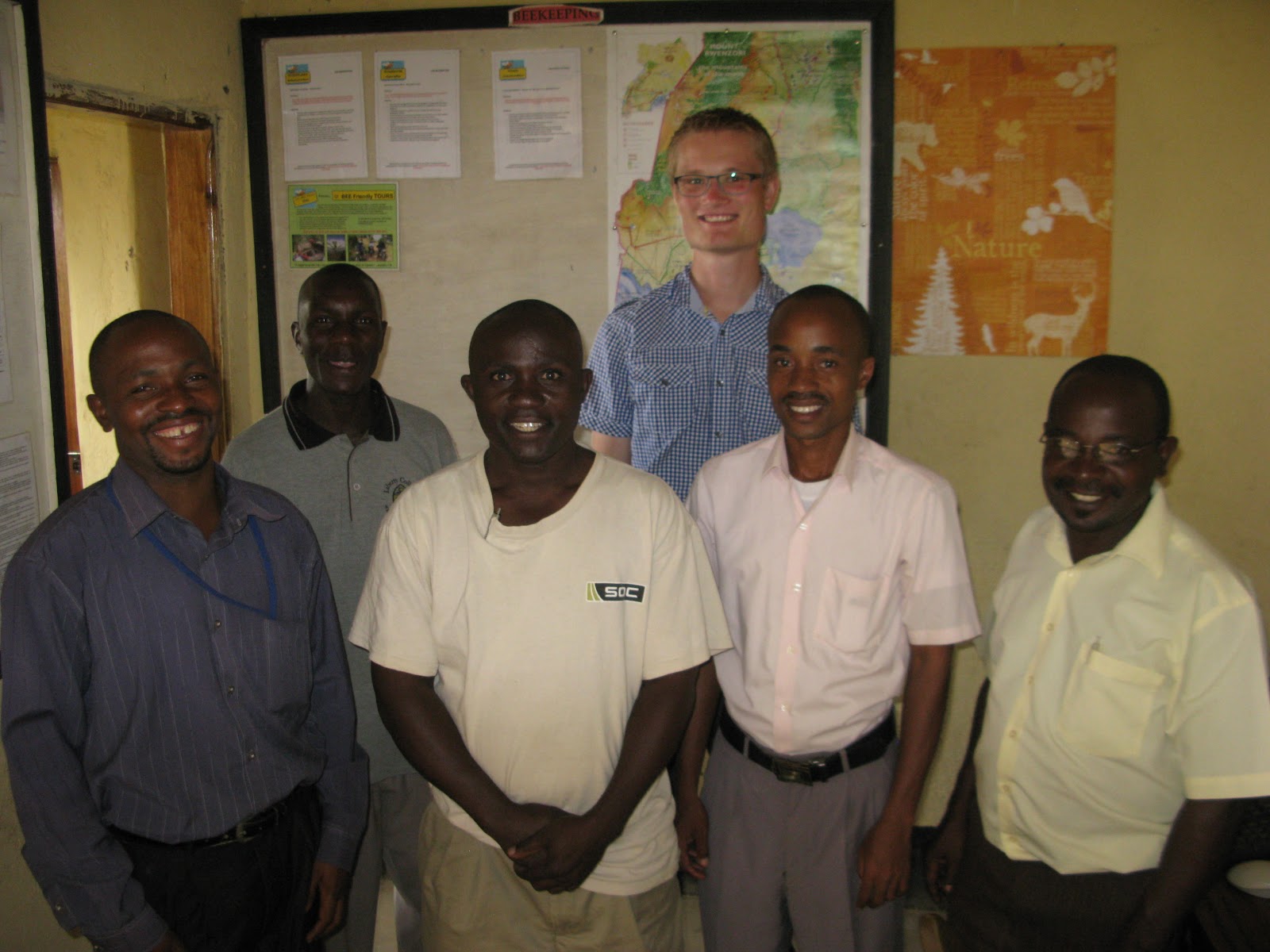
LIDEFO team from left to right John College deputy principal, Simon beekeeping field officer,  Jouckus honey processing manager, Remco intern from Holland, Julius finance officer LIDEFO, Daniel Director LIDEFO
Today I met my host organization the Liberty Development Foundation (LIDEFO) Uganda.  This organization was founded in 2002 by a group of men and women from the Kasese Municipal Council as a community based organization focused on education and vocational training for members of the community.  Beekeeping is just one small part of the organizations training programs; they are working with women and at risk youth in starting microenterprises.  They also offer professional classes through Liberty College in journalism, tourism, hotel management, accounting, early childhood development, business, and apparently much more.
Mr. Ngangasi inspecting the donated equipment

One of the founders Mr. Daniel Ngangasi is the director of the organization.  Paitence and I met with Mr. Ngangasi in his office to talk about the program for the next couple weeks.  He brought in his Beekeeping managers Simon the beekeeping field officer, and Jockous the honey processing center manager.  They were all extremely welcoming and patient answering all of my questions.   They were also over the moon excited about the honey harvesting equipment and protective gear that was donated.  Thanks again to everybody that made that happen.

Current honey house, more of a honey closet
new processing center
Their current honey processing facilities are extremely cramped and certainly won’t suffice for increased production, but Daniel explained that they are already in the process of building a honey-processing center where they can really expand.  I asked if I could go and see it not realizing that it was all the way on the other side of town.  But everybody gladly obliged, and we all loaded up in the CNFA truck for a field trip.  The building was much bigger, and it can also accommodate a selling shop.  Daniel explained that the building next door will also be a teaching facility and the land behind the buildings will be used for a demonstration apiary.  I can see Simon and Jockus leading regular workshops there someday.

LIDEFO honey blue label and yellow cap in Hossana Supermarket
Then we loaded up in the truck to go visit some shops in town that are currently selling LIDEFO honey.  I asked one of the vendors if people buy it.  She said that it was the best selling honey they have.  Granted it was the least expensive, but she said that people also bought it because they new it was local.  The other honeys on the self were from Kenya, the United Arab Emirates, and two other ones from different regions in Uganda. 
Inside the new honey processing center.

Next we went to Daniel’s wife Grace’s shop.  She also sells a lot of honey here, but more importantly this is the honey drop off center for farmers.  It was the perfect site for it because it is centrally located in the heart of town with a bus stage right next to it, so farmers can drop off their honey when they go into town to visit the shops.  It’s also ideal because she always has cash on hand from the shop’s sales, so she can pay the farmer immediately upon receiving the honey.  This a great system, because most small honey packers can’t pay their farmers until long after they have sold the honey, so they have to sign confusing contracts that leave the farmers unsatisfied.  In the evening the buckets of honey are picked up from Grace’s shop and brought over to the honey-processing center. 
Grace in Grace's shop

I think the LIDEFO is off to a great start.  I hope that the next two weeks trainings will encourage the farmers to expand their apiaries and start harvesting only capped honey for sale at the LIDEFO.  I also think we can figure out ways to better preserve a quality product throughout the packing process.  I think LIDEFO is doing a great thing in starting a honey packing business because they are providing a consistent market for the rural beekeepers of the area, while also reinvesting the enterprise’s profits into community projects.  I hope that as their business grows it can become a model for other community-based organizations to follow.  I also love that this was a community-started organization, and that it is still and always will be locally run.  They also have a great website for more information: www.lidefo.org


Wednesday, February 6, 2013

From Kampala to Kasese


I arrived at Entebe airport near Kampala late Saturday night.  I had barely slept on my two flights from New York to Amsterdam, and Amsterdam to Entebe, culminating in well over 24 hours of traveling.  I was greeted warmly by the customs clerk, I think she even called me darling.  I paid her the $50 for the Visa fee, but she pushed the bill back to me and said, “Give me a nicer bill.” I smiled and shrugged my shoulders and asked what was wrong with that one?  “It’s too old” she replied.  “Well it’s the only one I have.  I got it from the bank in New York City, it looks good to me” I said sheepishly holding onto my smile. “If it’s the only one you have than you don’t get a visa,” she stated with no trace of warmth left in her voice. She looked past me to nod the next traveler forward.  I dug into my suitcase for a newer bill.  A word to the wise if you travel to Uganda bring 2000 series $100 and $50 bills only or else you may not be able to use them, or you get a much lower price at the for-ex bureaus.  Go figure.

A driver from Fairway hotel was there to pick me and a Swiss Aquaculture specialist up from the airport in Entebbe and drive us the 40km to Kampala.  The driver’s name was Michael and he called me Danielle just like everybody in Malawi…that made me smile.  Suddenly everything was reminding me of Malawi; the dusty road, the smell of burning plastic from street sweepers burning their trash heaps, the bars blaring afro-pop music through blown out speakers with three customers dancing whistling and cheering like they were in a packed concert.  I felt like I was pulling into Mzuzu after a long day of traveling in Malawi. 

But this is not Malawi I had to remind myself.  I started asking Michael question after question about Uganda.  “Who is your favorite Ugandan musician.” He pointed at the radio and said “Julian Kanyomozi.” What is the staple food here?  “Matoke” he replied, “Plantains steamed in banana leaves then mashed.” When I asked him about the main religion in Uganda, he gave me the specific percentages for all of the major religious sects in the country; the man was a walking talking lonely planet book. 

We got to the hotel after 1am, I should have been fast asleep when I laid down, but I was still used to New York time where it was mid morning.  So I lay there thinking about what the next month will bring.  

Maribou Stork walking around like it owns the road. 
The next day was Sunday, so the CNFA staff gave it to me to recover from the flight. I walked to a shopping plaza to meet my friend from Peace Corps Malawi Jenny, and her fiancé Barak.  It was really nice to catch up with them and get some information about the area where I’m going, Barak is from Fort Portal which is about an hour north of Kasese,  They said the same thing as everybody.  It’s hot!  But he also talked about the mountains and the national parks.  I walked around Kampala a little and was amazed by the giant prehistoric looking birds I saw everywhere.   They seem fearless, and rightly so, they look big enough to carry away a small child.  I later found out that they are the marabou stork.

That evening Paitence Byruhanga the CNFA program coordinator came to pay me a visit at the hotel.  She is a very professional woman, and she has already done a fantastic job setting up the project, and briefing me on what the LIDEFO wants to get out of my time here. 

Again I had another sleepless night because of the jet lag.

Godfrey left, George right
That morning Paitence picked me up and introduced me to the rest of the CNFA staff: the country director George Ntibarikure, the driver Godfrey, the accounts manager Peace, and the administrative assistant Topi.  Everybody was very welcoming and helpful.  They briefed me on the project, safety and security issues and reporting on the project.

CNFA Uganda staff: George top left, Peace top center, Paitence top right, Topi front
We also went to visit the TUNADO office (The Ugandan National Apiculture Development Organization) and meet with the executive director Dickson Biryomumaisho.  The meeting was very helpful.  He explained to me the current situation for beekeepers in Uganda. Uganda beekeepers are producing about 500 tons of honey per year, exporting less than 10 tons, and importing about 70 tons.  So it seems like Ugandan beekeepers are still a long way from fulfilling the in country demand for honey, and the imports are still on the rise.  It sounds like beekeeping is the business to be in here right now if they can up their production. 

Dickson also explained what TUNADO does as an organization. They work to influence national policy regarding honey sales, while also advocating for Ugandan beekeepers among the greater population.  For example every year they host the National Honey week in Kampala, where Ugandan honey is showcased.  Dickson said that they really wanted to convince people that Ugandan honey is just as high of quality as anywhere else.  Dickson also explained what they do for beekeeper’s associations who become members.  They help with marketing, logistical planning with honey packers and literature like the Api-news newsletter and The National beekeeping training and extension manual.

I asked for his advice on anything to add to my workshops in Kasese.  His answer surprised me.  He said, “don’t advocate that anybody abandon the local traditional hives for “modern” hives and other expensive equipment.  Make sure that they plan to expand their honey production in the most cost effective way possible, instead of relying on outside donors.  If they rely on outside donors alone, then it is an unsustainable organization”  I was surprised only because I’m so used to hearing Agriculture extension people say invest to modernize, but he just says do whatever works best and is cost effective.  I appreciate that advice and the numbers agree with that sentiment as well.  A local hive might cost 6,000 Ugandan Shillings while a Kenyan Top bar hive might cost Ush 45,000 with only slightly higher honey yields.  All and all I’m very happy we got to meet with TUNADO and I hope it translates into a deal between the LIDEFO and TUNADO.  If anybody is looking for a good African beekeeping orginazation to support, TUNADO may be a great option.I didn't get a chance to delve into their system of oversight for tracking how donor dollars are tracked. But it certainly seemed to me that they work hard for the beekeepers, and they maintain a slim office budget to focus the money on services to the beekeepers.  Check their website to learn more about them www.Tunadobees.org.

CNFA brought me back to the hotel and I immediately fell asleep around 4pm.  I woke up around 6pm ate an avocado salad, and fell back asleep until 7am the next morning.  It was good to catch up on sleep!

That morning Paitence, Godfrey, and I set off for Kasese around 9:30am.  It was a beautiful drive.  I was impressed to see that most homes were surrounded by banana trees, and not maize like in Malawi.  The Maize that I did see had mostly dried on the stalk, which confused me since people had been saying that the rainy season was about to come.  Paitence explained to me that there were two rainy seasons, one from August to October, and another from March to May, so this Maize was planted back in August.

The greenness of Uganda is striking, even now in the dry season.  The number of trees that covers the landscape is also very impressive.  There seems to be a variety of natural forests still growing and plantations of timber trees like pine, keysha, and eucalyptus.  At first glance it seems like there is much less deforestation here than in Malawi, but I haven’t seen much of the country yet, and I certainly did see some bare hilltops behind villages probably cleared from firewood collection. 

Near Fort Portal we came upon expansive green tea plantations, that stretched over the rolling hills.  They were gorgeous under the massive African sky.  Giant white puffy clouds crept over the distant fields, letting slivers of afternoon light shine through and turn a few acres at a time from green to golden.  It’s sights like this that stop everything else that I am thinking about or working on and leave me in a state of awe and wonder.
Tea Fields near Fort Portal

We got into Kasese town in the late afternoon and got settled into our hotel.  Tomorrow I will meet The LIDEFO board, and the work begins! 

The road to Kasese

Sunday, February 3, 2013

Thank you for the support!


I owe a huge thank you to a number of people, beekeeping organizations, and businesses who have donated equipment to the beekeepers of Kasese and Mwazisi.  A number of members from the Backyard Beekeepers Association of Connecticut donated lightly used veils, gloves and hive tools.  Many members also donated money to buy equipment, along with $500 donated by the BYBA board of directors, and individual contributions from friends and colleagues at Stone Barns.


I used that money to buy beekeeping equipment from two great local beekeeping equipment companies Betterbee in Greenwich NY,  and Bee Commerce in Weston CT.  I bought full suits, because folks sure aren't kidding when you hear African honey bees are more defensive! I was once chased over a mile through Maize fields by an angry colony and stung in the head over 50 times (I looked like Marlon Brando for a week.)  I also bought lots of beekeeping gloves with elastic rings at the elbows, because as I remember from Malawi good protective gloves with dexterity are impossible to find.  Most people use the industrial rubber gloves meant for use with harsh chemicals, and they simply tie them off at the wrists.  The canvas gloves will be easier to work with, less hot, and safer.  I also bought lots of cloth bucket filters for the beekeepers to use filtering their own honey, and honey gates to be attached to settling tanks and buckets for easy jarring.  Both companies I bought from offered the equipment at a very low price and made generous contributions themselves.  In fact both companies donated refratometers (the two devices in the photo in grey and black cases) for use at the bulking centers which is a very important tool for determining the water content of honey to make sure that it won't ferment.  Bee Commerce also donated the stainless steel double sieves (above the refractometers in the photo) that will also be kept at the bulking centers for filtering honey before jarring.  Another CT beekeeping business  Honey Bee Farm LLC donated the two veils with the straw hats (near the top left corner of the photo) which will be nice on the particularly hot humid days.

I also used donated money to buy several beekeeping training books (left side of the photo) from a UK based NGO called bees for development.  These manuals were developed as lesson plans for teaching beekeeping groups in Africa, and they come with training cards that have clear photos.  The two books that I think will be of particular value for this project were specifically tailored to beekeeping in Uganda, they are Market access for beekeepers, and Information for honey packers.  These have both been incredibly informative in better understanding the current climate around beekeeping and honey selling in Uganda.  The other book in the photo is the Penn State Field Guide to Honey Bees and Their Maladies I got this from the Empire State Honey Producers Association.  I'm sure it's high resolution photos will be another good teaching tool.

The only items in the photos are Stone Barns t-shirts and patches which I bought as gifts for my hosts over the next three weeks.  I also brought Pocatico Hills Fire Department t-shirts and the extra shirts from the Young Farmers Conference as little mementos of my life in New York for the people of Kasese and Mwazisi.

Thank you very much to everybody who donated to this project and who is supporting this type of work.  If you do business with the above mentioned businesses, please thank them for their contributions.

Thursday, January 24, 2013

Reviving My Blog

It has been almost three years since I left Malawi, and even longer since I posted a blog on this page.  In May of 2010 I flew straight to New York from South Africa to start working at Stone Barns Center for Food and Agriculture, and quickly got swept up in the life I'm currently living.  Obviously a lot has happened in my life in that period of time.  I am engaged to marry my life partner and the women I love.  We've become Brooklynites, and bought a home in Sunset Park.  Beekeeping has become much more than a side project for me.  I've learned a tremendous amount from some of the best beekeepers in the northeast United States, and am always learning more and more.  I mange an expanding apiary at Stone barns while consulting and teaching a wide variety of bee keepers and bee lovers on the side.

Keeping the bees at Stone barns has led to one opportunity after another, and now it is leading to a chance to travel back to Africa.  I was offered an opportunity to volunteer on a project through the USAid farmer to farmer program in October of last year, and now I will leave for Uganda in one weeks time.  The project is being implemented by CNFA a DC based non-profit international development organization.  The project was requested by a Ugandan community based organization called the Liberty Development Organization (LIDEFO).  According to my scope of work report LIDEFO has mobilized 700 farmers (200 women and 500 men) in the Kasese region to establish apiaries and they are currently producing 2.5 metric tones of honey per harvest twice a year.  This may sound like a lot, but if you consider that it 700 farmers are harvesting each time, than that would mean about 6-8 lb. of honey per beekeeper, which is certainly on the low end.

The beekeepers in Kasese bring their honey to a bulking center where it is filtered and packed into half liter containers to be sold locally LIDEFO expressed that the Kasese beekeepers have been having problems with honey that has too high of a water content or has been contaminated.  My role will be to work with and observe the beekeepers throughout the process of harvesting, transporting, filtering, packaging, and storing to help identify hazards that compromise the final product.  We will then organize some trainings based on our findings, and ultimately produce a best practices manual that will be translated and distributed to the beekeepers.  It's essentially the same process that goes into developing a HACCP (Hazard Analysis Critical Control Point) plan.  I'm also planning sessions on wax processing, other bee products, making increase splits, and general apiary management.  I will be in Kasese working with the beekeepers for a week, then will work on the manual in Kampala at the CNFA offices.

It would be pure hubris to think that I am going to go there as a foreigner and revolutionize the way they keep bees and produce honey.  I am not going there with those delusions at all, but I do think that it is always valuable to get an outside perspective in any operation, and I fully intend to devote my complete focus and energy to giving the Kasese beekeepers the most helpful assessment I can.  In Malawi the best thing I did was empower a much more experienced local beekeeper than me to share his knowledge with enthusiastic learners.  His name was Bwana Mgogoninga and he was a fantastic teacher.  We organized several workshops together with great success.  I may not have the time to identify and develop a working relationship with somebody in Kasese like I did with Mgogoninga, but I can still highlight local knowledge instead of posing to have all of the answers.

I have been researching existing beekeeping projects in Uganda and I came across a wonderful UK based organization called Bees for Development who has worked a lot in Uganda, they have printed manuals on Market access for beekeepers and a guide to honey packing in Uganda,  I bought everything they offer related to Uganda and have gleaned lots of good information from them.  Bees for Development also put me in touch with a national beekeeping organization that they helped start called The Uganda National Apiculture Association (TUNADO)....man it's great to be bombarded by acronyms again! I will meet with the director of TUNADO the monday after I arrive in Kampala to get input from him on this project, and find out what support they can offer to the Kasese beekeepers.  Apparently LIDEFO has not worked with TUNADO up till now, so I look forward to seeing if this might be a beneficial relationship to foster between the two organizations.

Okay, so why am I writing about a project in Uganda in a blog called Dan in Malawi?  Well I couldn't imagine traveling all the way back to Africa and not seeing my friends in Malawi so I've decided to make a quick sojourn back to the warm heart of Africa.  When I'm done in Uganda, I will fly to Malawi for one week.  I already mentioned that a lot has happened in my life since I last wrote a blog post, well much more has happened in Mwazisi to be sure.  As I was leaving a cell tower was being built with in range of the trading center.  Now I hear the village has been connected to the electric grid!  The road has been paved to the trading center.  And there has been two more Peace Corps volunteers to serve in Mwazisi; the first one being my replacement Prashanth, who is finished and back home now, a the second Kristen an English teacher who is there now.   Also in the time since I left some of my students at the secondary school have moved on from Mwazisi, while others have had children and are making families in Mwazisi like thier parents.  I also know that some of the people I loved very much have died.  I have to realize that a trip back to Mwazisi won't just be happy reunions,  there will also be hard realities to deal with.  But the good always comes with the bad.  No matter what, I am excited to get back to Mwazisi, and I look forward to sharing both the good and the bad from the entire trip.   

Sunday, February 7, 2010

Back to Work in Mwazisi

I got back from home leave a little less than a month ago. It was great being home! I saw lots of people I love, played in the snow, and fully enjoyed the variety of creature comforts, food, and beer that America has to offer. But a month of leisure in the USA left my hands soft, my skin pale, and my heart a bit restless. I was happy to come back to Malawi in the midst of the chaos of the rainy season, and jump back into a full routine here.

I’ve said it before; I love the rainy season here! Life seems to spring from every hole, the landscape changes from brown and dusty to green and lush. Everybody is busy working away in their fields. Before sunrise I find my neighbours in the moonlight sleepwalking to their fields, jembe in hand, and sleeping baby strapped across their back. They’ll stay out their building ridges, planting, and weeding until a heavy rain falls, or the sun starts glaring down on the wet soil in all its steaming humid fury. Then most people will head back out to continue their work just as soon as the rain clears, or the afternoon sun cools enough to bear. Nobody seems stressed or rushing to get everything done but as their grain storages start to empty and Nyengo ya ngana ( time of hunger) sets in you can see a new determination and sense of urgency to produce food. This is when I most realize the difference between me and everybody else. For me farming is more of a pleasure and an ongoing experiment, but if my fields fail I’ll still be okay, but for everybody else it literally is their very livelihood.

I spent my first week back catching up on the rainy season work with my trusty helper Sam (my former secondary student, who started living with me while he finished up his last year of secondary school). We cleared the grass around my house that had grown up to my chest level and tilled new garden beds that we sowed vegetable seeds in. In the field we weeded all the maize and beans that we sowed before I left, and applied a chicken manure tea that has been curing for several months as a top dressing fertilizer for them. We finished ridging the other half of my field that I hadn’t gotten to yet. I inoculated about 5 KGs of cowpea seed with rizobium bacteria, which helps legumes to fix nitrogen into the soil. It occurs naturally in the soil, but there’s very little of the right bacteria for cow peas here because so few people plant them here anymore, despite the fact that it’s a very useful native crop. I planted cow peas in the rest of my ridges because hopefully it will make a great green cover crop that will continue growing and bearing fruit late into the dry season. I’m also going to try planting inoculated Pigeon Peas, though it’s a bit late for them. I think Pigeon Peas would be a great legacy to leave in my field; they grow as a tree that will live for 3-7 years, so if my replacement chooses not to farm, at least the land will still be productive, and the soil anchored.

Once I felt a bit caught up at home, I rounded up the guys and got back to construction of the office. We have worked hard for the past week and a half, 7:00am until sunset everyday, with just a short break for lunch. The long days have paid off though because we have made great progress. We have managed to finish the roof and all of the brick laying for beam filling minus about 39 iron sheets and about 100 bricks (I’m actually on my way to Mzuzu tomorrow to try to organize the last of the materials needed with the department of agriculture). We literally used every single last one of the 8,000 stabilized soil blocks that we moulded last year, so we will have to mould another hundred on Tuesday. I’m pretty impressed with how close our original estimation of the number of bricks was...we sure aren’t wasting materials here.

These past several weeks of work have really felt good. My old calluses are back, after a few red necked sunburns my old bronze has returned, and at the end of every day I turn on The Voice of America, to listen to my favourite music show “Border Crossings” while I scrub clean with a hot bucket bath, I don’t think there’s any better sensation in the world! Sam and I are both usually too tired to talk much while we wolf down soy pieces and nsima, or rice and greens.

I usually sit out behind my house while I brush my teeth before bed. I sit and scratch my dog Lucy’s belly while I look up at the stars, or watch the distant flashes of an oncoming thunderstorm. That’s one of my favourite rituals here, and it’s usually a time when I feel most appreciative for my life here. Before I left a returned Peace Corps volunteer told me to always remember the phrase “this too shall pass.” It works for all occasions; during the bad times you realize that they are going to pass soon so no need to worry, during the good times you know they are temporary, so really try to get the most out of them. Well now I’m realizing that my whole life here is going to pass. In three months I will no longer be a Peace Corps volunteer, and who knows if I’ll ever get back to Malawi again. This place that has been my home through good times and bad for the past three years will soon just be a memory to me. I feel like that realization has elated my senses. I try to memorize the sweet taste of every mango I eat from the tree in my field. I listen closely as the rain starts tapping on my tin roof at night anticipating the build up that will turn into the roar of a temporary downpour, and will just as quickly squeeze off its final trickle, leaving only the peaceful din of the crickets. I try to make the most of the warmth of every smile from my closest friends here, because I realize that the number of times I will feel that warmth from these individuals is now limited, and every night I spend a few extra minutes outside trying to imprint the glow of a perfect Mwazisi starry night in my mind.